

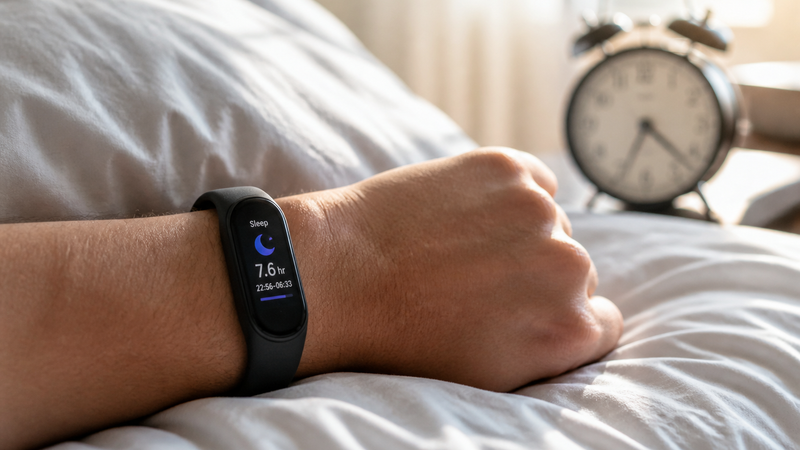
Your Sleep Tracker Says You Got 7 Hours — But Can You Trust It?
Wearables have gotten smarter, but sleep science is complicated. Here's what your device can and can't tell you about your night.
You woke up exhausted, but your smartwatch says you crushed it — eight hours, plenty of deep sleep, high sleep score. So who's right, you or the wristband? It turns out the answer is more nuanced than the app wants you to believe.
What Sleep Trackers Actually Measure
Consumer sleep trackers — think Fitbit, Apple Watch, Garmin, and Oura Ring — don't measure your brain. That's an important distinction. The gold standard for studying sleep in a clinical setting is polysomnography, a test done in a sleep lab that records brain waves, eye movements, heart rate, and breathing simultaneously.
Wearables on your wrist or finger instead use accelerometers to detect movement, optical sensors to track heart rate and blood oxygen, and algorithms to translate that data into estimated sleep stages. They're essentially making educated guesses about what your brain is doing based on how still you are and how your heart is beating.
Where the Research Stands
Studies published in the Journal of Clinical Sleep Medicine have compared consumer wearables against lab-based polysomnography, and the findings are mixed. These devices tend to be reasonably good at distinguishing sleep from wakefulness overall — most perform better than just lying still in bed. But when it comes to identifying specific sleep stages, particularly deep sleep and REM sleep, accuracy drops considerably.
A review of multiple wearable devices found that trackers frequently overestimate total sleep time and struggle to correctly classify lighter sleep stages. Study populations in this research have varied, and results differ by device and by individual, so no single number applies to every wearable on the market.
It's also worth noting that most of this research involves relatively small sample sizes, and the technology is evolving quickly. What's true for a device tested two years ago may not reflect the latest hardware and software updates.
The Upside: Trends Over Time
Here's where sleep trackers genuinely earn their keep. While any single night's data may not be perfectly accurate, tracking your sleep over weeks and months can reveal meaningful patterns.
If your tracker consistently shows shorter sleep on nights when you had alcohol, or better scores on nights when you exercised, those patterns are worth paying attention to — even if the exact minutes in each sleep stage are off. The American Academy of Sleep Medicine has acknowledged that consumer wearables can be useful tools for raising awareness about sleep habits, as long as users understand their limitations.
The Downside: Orthosomnia Is Real
Researchers have identified a phenomenon called orthosomnia — an unhealthy preoccupation with achieving perfect sleep tracker scores. Some people become so focused on hitting a certain number that the anxiety itself disrupts their sleep. The tracker meant to help them ends up working against them.
If you find yourself stressed about your sleep score before you even close your eyes, that's a sign the device may be doing more harm than good for you personally.
What to Do With Your Sleep Data
Use your tracker as one piece of information, not the final word. Ask yourself how you actually feel in the morning, how your energy holds up through the day, and whether you notice patterns connecting your habits to your sleep quality.
- Don't obsess over a single night's score — look for trends over weeks.
- Pay attention to how lifestyle factors like caffeine, alcohol, screen time, and exercise show up in your data.
- If you're consistently waking up tired regardless of what the app says, talk to your doctor. Conditions like sleep apnea require a clinical evaluation, not a wristband.
- If tracker anxiety is keeping you up at night, consider taking a break from it.
When to See a Doctor Instead
No consumer device can diagnose a sleep disorder. If you're snoring loudly, waking up gasping, experiencing excessive daytime sleepiness, or struggling with insomnia that doesn't respond to good sleep habits, a conversation with your doctor is the right next step. A proper sleep study can identify issues that no wristband will catch.
The Bottom Line
Sleep trackers can be a useful window into your nightly habits, but they're not a substitute for a sleep lab — or for how you actually feel. Use the data to spot patterns and spark conversations with your doctor, not to replace your own judgment. The most important measure of good sleep is still a simple one: do you wake up feeling rested?
