

After 50, Balance Training May Matter More Than You Think
You've been focused on building strength — but there's another fitness habit that may do more to protect your life after 50.
Most people over 50 who hit the gym are chasing muscle. And that's not a bad goal. But if balance training isn't part of your routine, you may be missing the piece that matters most for staying active, independent, and injury-free as you get older.
The Fall Problem Is Bigger Than Most People Realize
Falls are the leading cause of injury-related death among adults 65 and older in the United States, according to the Centers for Disease Control and Prevention (CDC). Each year, millions of older adults are treated in emergency rooms for fall-related injuries, and hundreds of thousands are hospitalized for hip fractures alone.
Here's the part that surprises most people: many of those falls happen to adults who are otherwise reasonably fit. Strength in the gym doesn't automatically translate to the kind of quick, reactive stability your body needs when you slip on a wet floor or misstep off a curb.
Why Balance Declines With Age — and Why It Sneaks Up on You
Balance is controlled by a team effort inside your body: your inner ear, your vision, and the sensors in your muscles and joints that tell your brain where you are in space. That last system is called proprioception, and it tends to decline gradually after age 40.
The problem is that the decline is subtle enough that most people don't notice it until something goes wrong. Research published in journals including Age and Ageing has found that balance performance measurably declines across middle age and accelerates in later decades.
Unlike muscle loss, which many people feel as weakness, balance loss often shows up as a near-miss — a stumble you caught, a moment of wobbliness getting out of the car — before it leads to a real fall.
What the Research Says About Balance Training
The good news is that balance is trainable at any age. Studies reviewed by the World Health Organization and published in journals such as the British Journal of Sports Medicine have found that exercise programs that include balance and coordination components can significantly reduce fall risk in older adults.
A widely cited Cochrane review — a large analysis of multiple clinical trials — found that balance and functional exercise programs reduced both the rate of falls and the number of people who experienced falls among older adults living in the community. The evidence was strong enough that balance training is now a standard recommendation in fall-prevention guidelines from organizations including the CDC and the American Geriatrics Society.
Importantly, that research generally points to balance-focused exercise rather than strength training alone. Building muscle matters, but it doesn't fully substitute for the specific neural and coordination work that balance training provides.
What Balance Training Actually Looks Like
You don't need special equipment or a gym. Some of the most effective balance work happens on a simple floor with no gear at all. Here are exercises that research-backed fall-prevention programs commonly include:
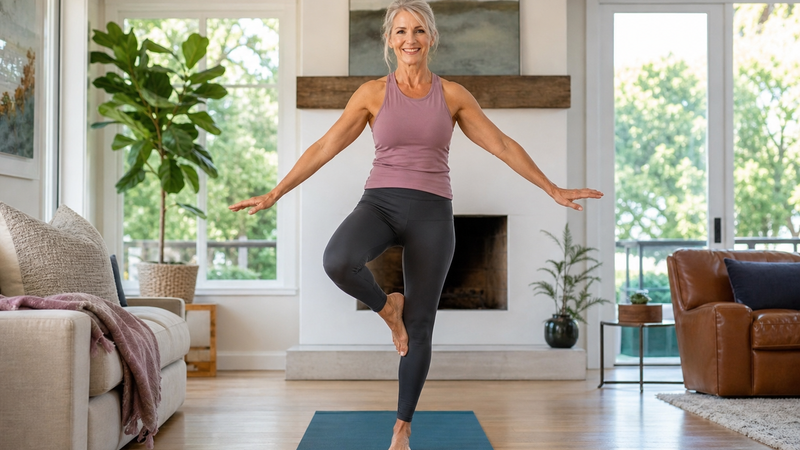
- Single-leg stands: Stand on one foot for 10 to 30 seconds, then switch. Progress to doing it with eyes closed.
- Heel-to-toe walking: Walk in a straight line placing the heel of one foot directly in front of the toes of the other, like walking a tightrope.
- Sit-to-stand without using hands: Rising from a chair without pushing off with your arms builds leg strength and trains the balance system together.
- Tai chi: Multiple studies have found tai chi to be one of the most effective movement practices for reducing fall risk in older adults, partly because it trains slow, controlled weight shifting.
- Yoga: Balance-focused yoga poses engage the same proprioceptive systems and have shown benefits in several smaller studies, though more research is still needed.
Even 10 to 15 minutes of balance-focused movement a few times a week can make a difference, according to exercise guidelines. The key is consistency and gradual progression — making the exercises slightly harder over time as your stability improves.
Strength Still Matters — Here's How to Think About Both
This isn't an argument against strength training. Strong legs, hips, and core muscles are part of what keeps you upright and helps you recover when you do stumble. Strength and balance work together.
The practical takeaway from the research is that balance training is often the missing piece — the thing most adults skip because it doesn't feel as obvious as lifting weights or doing cardio. For adults over 50, adding dedicated balance work to whatever you're already doing may offer protection that strength training alone doesn't fully provide.
If you have a history of falls, dizziness, joint problems, or a neurological condition, talk with your doctor before starting a new balance routine. A physical therapist can also design a program specifically tailored to where you are right now.
The Bottom Line
Strength training is valuable, but after 50, balance training may be the more urgent priority. Falls are a leading cause of serious injury and loss of independence in older adults — and research consistently shows that targeted balance exercise can lower that risk. The moves are simple, require no equipment, and can be done in minutes a day. If your current fitness routine doesn't include balance work, now is a good time to add it. Talk to your doctor or a physical therapist about where to start.
