

If your sleep quietly went from reliable to unpredictable somewhere around your fiftieth birthday, you're not imagining it. Aging changes sleep in specific, measurable ways — here's the biology, and what actually helps.
The Biology Behind the 3 A.M. Wake-Up
Sleep isn't just shorter as you age — it's structurally different. Deep sleep, the most restorative stage, declines steadily over the decades, dropping from roughly 19% of total sleep time in early adulthood to about 3–4% by midlife, replaced by lighter, more easily disrupted sleep. By the 60s and 70s, deep sleep can shrink to under 10% of total sleep time. That matters because deep sleep is when your body handles physical repair and memory consolidation — losing it shows up the next day as brain fog and a short fuse.
Total sleep time also drops by roughly 27 minutes per decade, alongside more frequent nighttime awakenings, with research identifying a distinct decline that kicks in after age 50.
Why Melatonin Drops Off a Cliff
Natural melatonin production, the hormone that signals bedtime, declines gradually with age and is closely tied to reduced sleep efficiency. Some estimates put the drop at up to 70% from middle to older age, with pineal gland studies showing melatonin output in 80-year-olds at roughly a tenth of teenage levels. Less melatonin means a weaker "lights out" signal.
Meanwhile, the brain's internal clock weakens over time, pushing older adults toward earlier bedtimes, earlier wake-ups, and more fragmented sleep in between. Rising nighttime cortisol compounds the problem, making middle-of-the-night wake-ups more likely and harder to recover from.
For Women: Menopause Adds a Second Layer
For women, perimenopause and menopause compound age-related sleep changes significantly. Between 40% and 60% of women in this transition report meaningful sleep difficulties, with diagnosable sleep disorders climbing as high as 60% after menopause.
Declining estrogen destabilizes temperature regulation, triggering hot flashes and night sweats. Declining progesterone removes a naturally sedative hormone, leading to lighter, more fragmented sleep. Notably, many women wake up just before a hot flash starts, suggesting the same brain changes causing the hot flash may be triggering the awakening itself.
What Actually Helps
Consistent sleep-wake times, no screens an hour before bed, and a cool bedroom (60–67°F) are foundational, especially for women managing hot flashes. For persistent insomnia, cognitive behavioral therapy for insomnia (CBT-I) is the frontline clinical treatment, with strong evidence even for perimenopausal women.
Magnesium has modest evidence: a review of randomized trials in older adults found it cut time-to-fall-asleep by about 17 minutes versus placebo. However, the effect on total sleep time wasn't statistically significant. Melatonin supplementation is also worth discussing with a doctor given how sharply natural production falls with age. For women with severe hot flashes disrupting sleep, hormone therapy is a conversation worth having with a gynecologist.
Where a Combination Formula Fits In
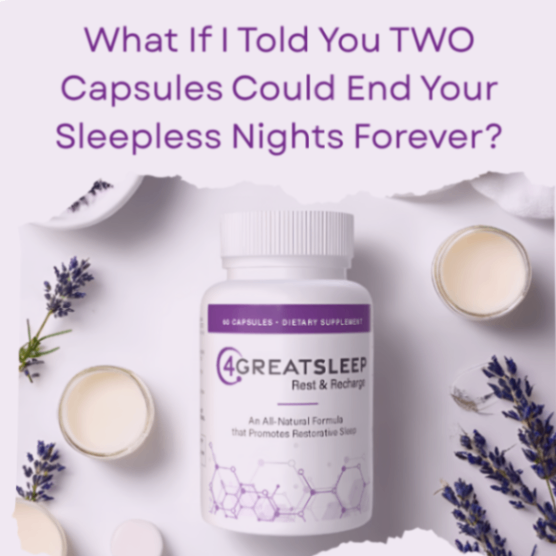
Because age-related sleep disruption often involves several systems at once — falling melatonin, rising cortisol, reduced physical relaxation — some people look at multi-ingredient formulas rather than melatonin alone. 4GreatSleep is one option in this category, combining melatonin with magnesium citrate, L-theanine, GABA, ashwagandha, and calming botanicals like chamomile and passionflower. It's NSF-certified, meaning an independent third party verifies label accuracy — notable given that supplement labels are otherwise self-reported.
No supplement replaces a conversation with your doctor, especially if hot flashes or chronic insomnia are the underlying driver.
Advertising disclosure: This article includes a paid mention of 4GreatSleep. We may earn a commission on purchases made through the link above.
These statements have not been evaluated by the FDA. This product is not intended to diagnose, treat, cure, or prevent any disease. This article is for informational purposes only and is not a substitute for medical advice. Consult a physician before starting any supplement.

