

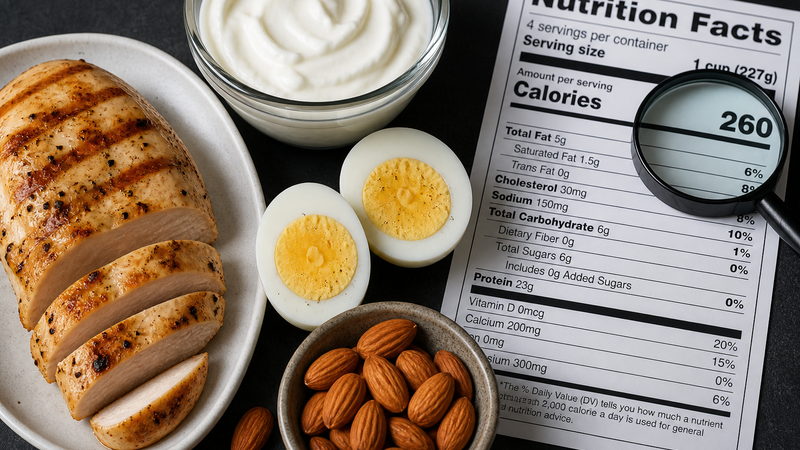
Protein Calories May Be Sneakier Than Your Food Label Admits
The number on your nutrition label may be telling you less than you think — and protein is at the center of the story.
You scan the nutrition label, count your calories, and feel confident you know exactly what you're getting. But what if protein doesn't quite work that way? Research suggests the calories your body actually uses from protein may be lower than what the label says — and that gap could change how you think about your diet.
Where Calorie Numbers Come From
The calories listed on food labels are based on a system developed in the late 1800s by chemist Wilbur Atwater. His method assigned a standard calorie value to each macronutrient: 4 calories per gram of protein and carbohydrates, and 9 calories per gram of fat.
That system has served as the foundation of nutrition labeling for well over a century. The problem is that it was designed as an average, and the human body doesn't always follow averages.
Why Protein Is Especially Complicated
Protein requires more energy to digest than fat or carbohydrates. This is called the thermic effect of food. Your body burns roughly 20 to 30 percent of the calories in protein just breaking it down and processing it — compared to about 5 to 10 percent for carbohydrates and as little as 0 to 3 percent for fat.
That means the net calories you absorb from a 100-calorie serving of protein may actually be closer to 70 to 80 calories in real-world terms. The label doesn't reflect that difference.
Cooking and Processing Change the Picture Too
How a food is prepared also affects how many calories your body extracts from it. Research published in the American Journal of Clinical Nutrition has shown that cooking generally increases the digestibility of protein — meaning your body absorbs more of it from cooked meat than raw. Processing, grinding, and heat all make nutrients more or less available depending on the food.
Whole almonds, for example, have been studied as a case where the body absorbs fewer calories than the label suggests, because some of the fat and protein remain trapped inside intact cell walls and pass through undigested. This kind of real-world variation rarely shows up on a package.
What This Means for High-Protein Diets
If you're eating more protein to manage your weight — a strategy backed by a solid body of research — this metabolic math works in your favor. The higher thermic effect of protein means your body is doing more work just to process it, which may support a modest calorie deficit without you cutting a single thing from your plate.
It also helps explain why two diets with the same total calories on paper can produce different results in practice when one is higher in protein. The label calories are a useful starting point, but they're not the whole story.
Don't Throw Out Your Labels — Just Understand Their Limits
None of this means you should stop reading nutrition labels. They remain one of the most practical tools you have for comparing foods and tracking general intake. The Atwater system, despite its age, gives a reasonably consistent framework across products.
What it does mean is that labels are estimates, not exact measurements. Your body is not a calculator. Two people eating identical meals can absorb different amounts of energy based on their gut microbiome, metabolism, and the specific form the food is in.
Practical Steps Worth Taking
- Prioritize protein at each meal — not just for muscle, but because it keeps you full longer and costs your body more energy to process.
- Choose whole food protein sources like eggs, fish, legumes, and plain Greek yogurt when possible, since processing affects digestibility in ways the label won't tell you.
- Don't stress over single-digit calorie differences. Focus on overall dietary patterns rather than precise numbers.
- If you are managing a condition like diabetes or kidney disease, talk with your doctor or a registered dietitian before making significant changes to your protein intake.
The Bottom Line
The calorie count on your protein-rich foods is a reasonable estimate — but it's not an exact science. Because protein takes more energy to digest and absorb than other nutrients, the net calories your body actually uses may be lower than the label suggests. That's not a loophole or a diet trick. It's just how metabolism works. Eating enough quality protein remains one of the most well-supported strategies for feeling full, staying strong, and managing your weight as you age.
