

Beyond LDL: The Cholesterol Numbers That Matter Most After 40
Your standard cholesterol test may be leaving out one of the most important numbers your doctor should see.
Most people leave their annual physical knowing two things: their LDL is either good or bad, and they should probably eat less saturated fat. But cardiologists increasingly say that picture is incomplete. There is a number called ApoB that many experts consider a sharper predictor of heart disease risk — and most routine lab panels don't include it.
Here's what every adult over 40 should know before their next blood draw.
The Standard Panel: A Good Start, But Not the Whole Story
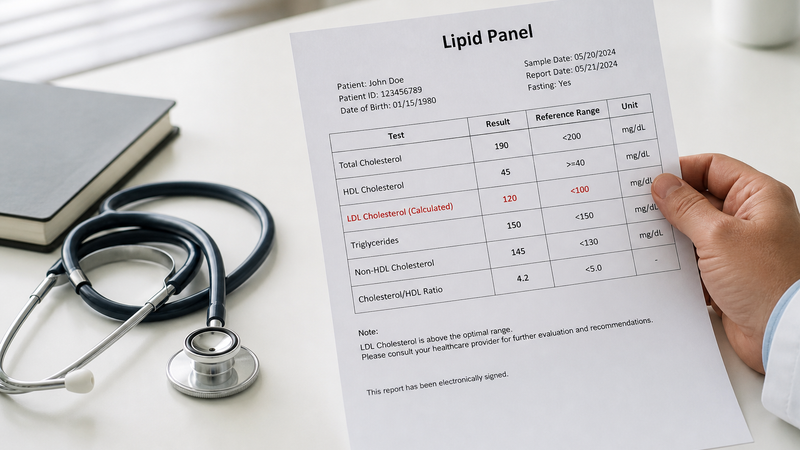
A typical lipid panel measures four things: total cholesterol, LDL (often called "bad" cholesterol), HDL ("good" cholesterol), and triglycerides. These numbers have guided heart disease prevention for decades, and they are still useful.
But LDL has a known limitation. It measures the amount of cholesterol carried in LDL particles, not the number of particles themselves. That distinction turns out to matter quite a bit.
Why Particle Count May Matter More Than Cholesterol Amount
Think of LDL particles like boats carrying cholesterol through your bloodstream. Two people can have the same total amount of cargo, but one has it spread across many small boats and the other has it on a few large ones. Research published in journals including JAMA Cardiology and the European Heart Journal suggests that the person with more boats — more particles — faces a higher risk of those particles getting lodged in artery walls, even if their LDL cholesterol number looks similar.
This is where ApoB comes in. Apolipoprotein B, or ApoB, is a protein that sits on the surface of every LDL particle (as well as VLDL and other atherogenic particles). One ApoB per particle means that measuring ApoB gives doctors a direct count of how many potentially artery-clogging particles are circulating in your blood.
What the Research Shows
Multiple large studies and meta-analyses have found that ApoB is at least as good as LDL — and in many cases a stronger predictor — of cardiovascular events like heart attack and stroke. The American Heart Association and the European Society of Cardiology have both acknowledged ApoB as a valuable risk marker, particularly for people whose standard LDL looks normal but who may still carry elevated risk.
This is especially relevant for people with metabolic syndrome, type 2 diabetes, obesity, or high triglycerides. In these individuals, LDL particle number and LDL cholesterol can diverge significantly, and relying on LDL alone may underestimate risk. It is important to note that research in this area continues to evolve, and not all clinical guidelines have fully standardized ApoB testing yet.
The Numbers You Should Know
Here is a plain-English guide to the key markers on a comprehensive lipid panel:
- LDL Cholesterol: General targets vary by individual risk level. Your doctor will set a goal based on your overall health history. For most adults, lower is considered better.
- HDL Cholesterol: Higher is generally better. Low HDL is considered a risk factor for heart disease.
- Triglycerides: Ideally below 150 mg/dL. High triglycerides are often linked to diet, excess weight, and insulin resistance.
- ApoB: Many cardiologists consider a level below 90 mg/dL reasonable for average-risk adults, and below 70 mg/dL for those at higher risk — though your doctor will interpret your result in the context of your full health picture.
- Lp(a): Lipoprotein(a) is another marker gaining attention. It is largely genetically determined and is an independent risk factor for heart disease. The American Heart Association recommends most adults have it measured at least once.
Who Should Ask About ApoB Testing
ApoB testing is not yet standard on every routine lab panel, but it is widely available and generally covered by insurance when ordered by a physician. You may want to bring it up with your doctor if you have a family history of early heart disease, if your triglycerides are high, if you have diabetes or metabolic syndrome, or if your LDL looks normal but you still have cardiovascular risk factors.
This is not a test everyone urgently needs — it is a conversation worth having with your doctor, particularly if your standard numbers have ever left you with unanswered questions about your true risk.
What You Can Do Right Now
While you sort out which tests to ask for, the lifestyle habits that protect heart health remain consistent across all risk markers:
- Eat a diet rich in vegetables, fiber, and healthy fats like those found in olive oil, nuts, and fatty fish
- Limit ultra-processed foods, refined carbohydrates, and added sugars, all of which can drive up triglycerides and LDL particle number
- Move your body regularly — even 30 minutes of brisk walking most days is linked to better lipid profiles
- Maintain a healthy weight, since excess body fat, especially around the abdomen, is closely tied to worse cholesterol and ApoB levels
- Avoid smoking, which directly damages artery walls and worsens every cholesterol-related risk factor
The Bottom Line
Your standard cholesterol test is a useful starting point, but it may not tell the complete story — especially if you are over 40 and have other risk factors. ApoB is a well-researched marker that many cardiologists consider one of the most accurate ways to gauge how many artery-damaging particles are in your blood. Ask your doctor whether adding ApoB and Lp(a) to your next lab order makes sense for you. Knowing your full numbers is one of the most proactive steps you can take for your long-term heart health.
