

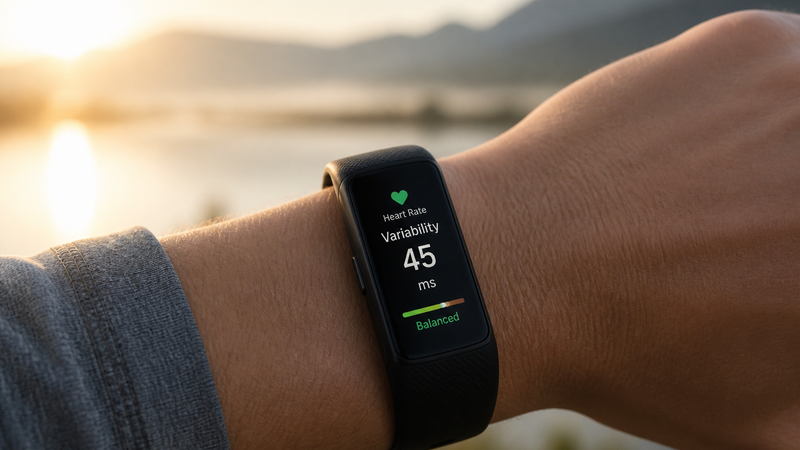
Heart Rate Variability: What Your Wearable Is Really Telling You
Your smartwatch tracks it every night — but do you actually know what HRV means, and when paying attention to it helps versus hurts?
You glance at your fitness tracker in the morning and see your heart rate variability score. It's lower than yesterday, and suddenly you're convinced something is wrong. Sound familiar? HRV is one of the most talked-about metrics in the wearable health space — and also one of the most misunderstood.
Here's what the science actually says — and when it makes sense to pay attention.
What Heart Rate Variability Actually Is
Your heart doesn't beat like a metronome. There are tiny variations in the time between each beat, measured in milliseconds. That variation is heart rate variability, or HRV.
A higher HRV generally means your autonomic nervous system — the part that controls your heart, digestion, breathing, and stress response — is flexible and responsive. A lower HRV can suggest your body is under stress, whether from illness, poor sleep, overtraining, or emotional strain.
HRV is not a new concept. It has been used in clinical research and sports medicine for decades. What's new is that consumer wearables like Apple Watch, Fitbit, Garmin, and Oura Ring now estimate it overnight and serve you a daily number.
What a Good HRV Score Looks Like — And Why Comparison Is Tricky
Here's something the fitness influencers rarely mention: HRV varies enormously from person to person. A score that's perfectly healthy for a 55-year-old woman may look very different from what's normal for a 35-year-old male athlete.
Age plays a big role. HRV tends to decline naturally as we get older. Sex, fitness level, body size, genetics, and even the time of day you measure all influence the number. Research published in journals including Frontiers in Physiology has documented wide natural variation across healthy populations.
The number that matters most is your own baseline over time — not a comparison to someone else's score or an app's color-coded target range.
What Low HRV May Signal — And What It Doesn't Prove
In research settings, chronically low HRV has been associated with higher risk of cardiovascular disease, depression, anxiety, and poor metabolic health. That's worth taking seriously.
But a single low reading on a Tuesday morning? That's almost certainly noise. Poor sleep the night before, a glass of wine, a stressful afternoon, or even eating a large meal close to bedtime can all temporarily drop your HRV. So can dehydration, a minor cold, or simply being in a warm room when you woke up.
Consumer wearables also have real limitations. They estimate HRV using optical sensors on your wrist, which are less precise than the clinical gold standard — an electrocardiogram (ECG) with chest electrodes. Studies have found meaningful differences between wearable estimates and clinical measurements, so treat your device's number as a trend indicator, not a medical test result.
What Actually Moves the Needle on HRV
The lifestyle factors that researchers have linked to higher, healthier HRV over time are probably not surprising — but they're worth knowing because they give you something actionable to do.
- Regular aerobic exercise is one of the most consistently supported ways to improve HRV, according to research in sports physiology. Even moderate-intensity walking and cycling show benefits.
- Quality sleep matters enormously. HRV tends to be highest during deep, slow-wave sleep and drops when sleep is fragmented or shortened.
- Stress management has measurable effects. Practices like slow diaphragmatic breathing, meditation, and yoga have been studied in clinical trials and linked to short- and long-term HRV improvements.
- Alcohol reduction is one of the clearest HRV levers. Even moderate drinking has been shown in research to suppress HRV the night it's consumed.
- Staying hydrated and maintaining a consistent sleep and wake schedule also appear to support autonomic nervous system balance.
None of these require a wearable to implement. They are simply good health habits backed by solid evidence.
When Watching HRV Becomes Counterproductive
Here's the irony worth naming: obsessing over your HRV score can actually lower it.
Anxiety about health metrics is a real phenomenon. Researchers and clinicians have noted that some wearable users develop what's sometimes called "orthosomnia" — sleep anxiety driven by tracking data — and a similar pattern can emerge around HRV. Waking up and immediately checking a number, then feeling anxious when it's lower, adds stress to your morning before the day has even started.
If you find yourself changing your plans, skipping workouts out of excessive caution, or feeling worried most mornings because of a wearable score, it may be time to step back. Your device is a tool, not a verdict.
When to Actually Talk to Your Doctor
A single low HRV reading is not a reason to call your cardiologist. But there are situations where your HRV data can be a useful conversation starter.
If you notice your HRV trending consistently lower over several weeks — especially alongside symptoms like unusual fatigue, shortness of breath, irregular heartbeat, or mood changes — that's worth bringing up with your doctor. They can put that trend in context with a full clinical picture, including any testing that's actually appropriate for your situation.
Never start or stop a medication, change a treatment plan, or make a diagnosis based on a wearable reading alone. Talk to your doctor.
The Bottom Line
HRV is a genuinely interesting window into your autonomic nervous system, and the research behind it is real. But your daily wearable score is an estimate, not a clinical measurement — and a single number on any given morning tells you very little. Focus on the long-term trend, not the daily fluctuation. The habits that support healthy HRV — consistent exercise, quality sleep, stress management, and cutting back on alcohol — are the same ones that support your overall health. Use your tracker as a nudge toward those habits, not as a source of daily anxiety.
