

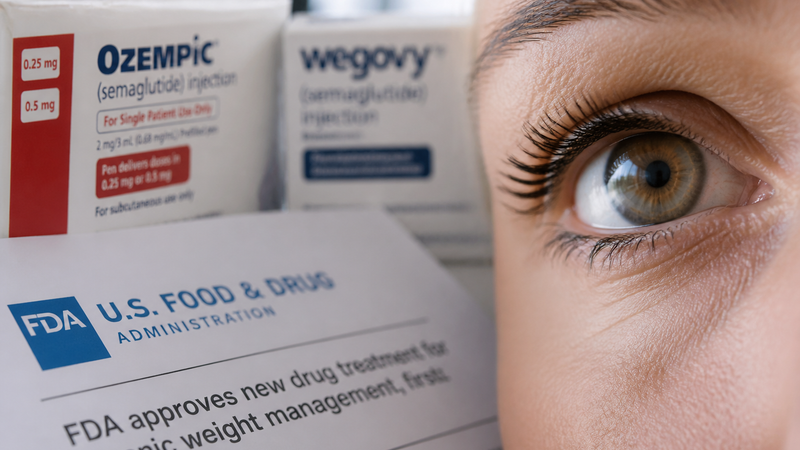
FDA Orders New Warning on GLP-1 Drugs Over Risk of Sudden Blindness — What Users Need to Know
If you or someone you love takes a GLP-1 medication for weight loss or diabetes, there is a new FDA warning you need to hear about.
Millions of Americans take GLP-1 receptor agonist drugs for type 2 diabetes and weight management. Now the FDA has ordered new warning labels on this class of medications after reports linking their use to a rare but serious eye condition that can cause sudden vision loss.
Here is what the warning means, what the research shows, and what to do if you are currently on one of these drugs.
What the FDA Actually Said
The U.S. Food and Drug Administration has required updated labeling for GLP-1 receptor agonist medications to include a warning about a condition called non-arteritic anterior ischemic optic neuropathy, or NAION. NAION is a form of damage to the optic nerve caused by reduced blood flow, and it can result in sudden, painless vision loss — sometimes permanent — in one or both eyes.
This action came after the FDA reviewed reports submitted through its pharmacovigilance system and evaluated published research suggesting a possible link between GLP-1 drug use and NAION.
What Does the Research Show?
A study published in JAMA Ophthalmology in 2024 examined medical records from a large database and found that patients with type 2 diabetes or obesity who were taking semaglutide — the active ingredient in Ozempic and Wegovy — had a higher rate of NAION compared to patients taking other medications for the same conditions.
Among patients with type 2 diabetes, those on semaglutide were roughly four times more likely to be diagnosed with NAION over the follow-up period than those on non-GLP-1 diabetes drugs. Among patients taking semaglutide for obesity, the rate was approximately seven times higher compared to those on non-GLP-1 weight-loss medications.
It is important to understand what this study does and does not tell us. It was an observational study using insurance and medical record data, which means it can identify an association but cannot prove that semaglutide directly caused the cases of NAION. The study also had limitations, including the possibility that other health factors in these patients — not the drug itself — contributed to their risk. The researchers called for further study to better understand the relationship.
How Rare Is NAION?
NAION is considered an uncommon condition in the general population. It is more likely to occur in people who already have certain risk factors, including small optic nerve anatomy, high blood pressure, diabetes, sleep apnea, and high cholesterol.
The absolute number of cases observed in research studies is still relatively low, and the FDA's warning is not a recall or a recommendation to stop taking these medications. It is a signal that patients and doctors should be aware of and monitor for.
Warning Signs to Watch For
Because NAION can come on suddenly, knowing the symptoms matters. Contact your doctor or seek care promptly if you experience any of the following while taking a GLP-1 medication:
- Sudden blurry or dim vision in one eye
- A dark spot or shadow in your field of vision
- Sudden loss of side vision
- Any rapid, unexplained change in your eyesight
These symptoms should never be ignored or waited out. Early evaluation by an eye care provider is important.
Should You Stop Taking Your GLP-1 Drug?
That is a conversation to have with your doctor — not a decision to make on your own. GLP-1 medications have well-documented benefits for blood sugar control, weight management, and in some cases cardiovascular health. For many patients, those benefits are significant.
Your doctor can help you weigh the potential risks against the benefits in the context of your personal health history, including whether you have any of the risk factors associated with NAION. If you have a history of eye problems or any of the risk factors listed above, it is especially worth raising this topic at your next visit.
The Bottom Line
The FDA has added a new warning to GLP-1 drugs like semaglutide and tirzepatide after research suggested a possible link to a rare eye condition that can cause sudden vision loss. The evidence points to an association, not a proven cause-and-effect relationship, and the absolute risk appears to be low. But the warning is real, the symptoms can be serious, and every patient taking these medications deserves to know about it. If you are on a GLP-1 drug, talk with your doctor about this update and report any sudden changes in your vision right away.
