

AI Can Now Estimate Your Heart Age From an Ultrasound — Here's What That Means
Artificial intelligence can now estimate how old your heart is — not your age on paper, but how well your heart is actually functioning. Here's what the science says so far.
You know your birthday. But do you know how old your heart really is? A wave of new AI-powered tools is trying to answer that question — by analyzing ultrasound images of the heart and estimating its biological age. And the gap between your heart's age and your calendar age could be a powerful early warning sign of trouble ahead.
What Is "Heart Age" — and Why Does It Matter?
Your chronological age is simply how many years you've been alive. Your biological heart age is something different: it reflects how well your heart is actually functioning compared to what's typical for people your age.
A heart that looks and performs younger than expected is generally a good sign. A heart that looks older — meaning it shows wear and reduced function beyond what your age would predict — may signal elevated risk for conditions like heart failure or cardiovascular disease, even before symptoms appear.
That's the idea driving a growing field of AI-assisted cardiac imaging research.
What the Research Has Found
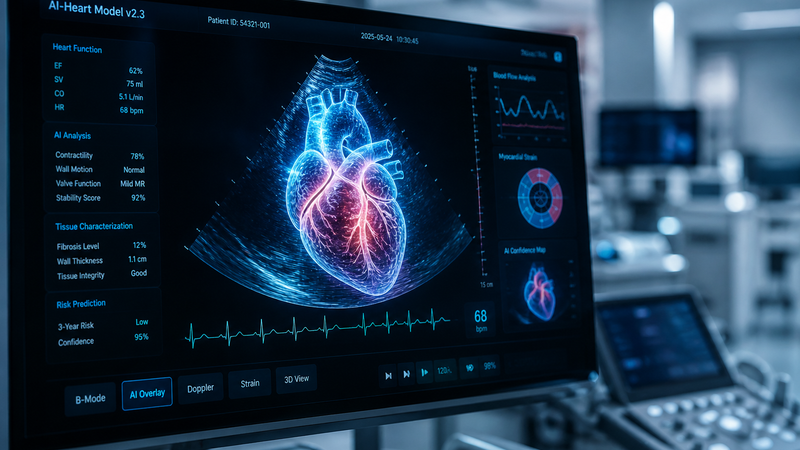
Scientists have trained artificial intelligence models on thousands of echocardiograms — the standard ultrasound test used to look at the heart's structure and motion. The AI learns patterns in how the heart moves, pumps, and fills, and uses those patterns to estimate biological age.
In studies published in leading cardiology journals, these AI models have shown they can predict a patient's age fairly accurately from an echocardiogram alone. More importantly, researchers found that when the AI estimated a heart to be significantly older than the patient's actual age, those patients tended to have worse health outcomes over time, including higher rates of heart failure and death from cardiovascular causes.
One notable line of research, conducted at institutions including the Mayo Clinic, found that the difference between AI-estimated heart age and real age — sometimes called the "cardiac age gap" — was meaningfully linked to future cardiovascular risk. It is important to note that these are observational studies, meaning they identify associations, not direct causes. The research is promising but still evolving.
How the Technology Works
During a standard echocardiogram, a technician uses a handheld wand to capture video images of the heart from several angles. The AI analyzes those images, looking at dozens of features — how the heart muscle contracts, how the valves move, how the chambers fill and empty — and synthesizes all of that into an estimated biological age.
The process happens in the background and doesn't require any extra steps for the patient. If this technology becomes routine, your echo report could one day include not just measurements, but an estimated heart age alongside them.
Should You Trust the Result?
Here's where some healthy skepticism is warranted. This technology is real and the early findings are genuinely interesting — but there are important limitations to keep in mind.
First, most of the studies conducted so far have been done in specific patient populations, often people who were already having echocardiograms for a clinical reason. That means the results may not apply equally to everyone. Second, AI models can reflect the biases in the data they were trained on, which is an active area of concern in medical AI research. Third, an estimated heart age is not a diagnosis. It is a signal — one piece of information that needs to be interpreted alongside your full medical history, lifestyle, and other test results.
Experts in the field consistently emphasize that AI tools like this are designed to assist physicians, not replace clinical judgment. If you ever receive a result suggesting your heart age is older than expected, that is a reason to have a conversation with your doctor — not a reason to panic.
What You Can Do Right Now
You don't need an AI-powered echocardiogram to start taking better care of your heart. The lifestyle factors that slow biological aging in the heart are well established.
- Move regularly. Even moderate exercise — like brisk walking most days — supports heart function and helps keep blood pressure in a healthy range.
- Eat to support your heart. Diets rich in vegetables, fruits, whole grains, and healthy fats have consistently been linked to lower cardiovascular risk.
- Manage blood pressure and blood sugar. Both are major drivers of accelerated cardiac aging. Know your numbers and talk to your doctor if they are out of range.
- Don't smoke. Smoking is one of the most powerful accelerators of cardiovascular aging known to medicine.
- Prioritize sleep. Poor sleep is increasingly linked to higher cardiovascular risk in large population studies.
If you are over 40 and have risk factors for heart disease — including high blood pressure, high cholesterol, diabetes, obesity, or a family history of heart problems — talk to your doctor about whether a cardiology evaluation makes sense for you.
The Bottom Line
AI-powered tools that estimate biological heart age from ultrasound images represent a genuinely exciting development in preventive cardiology. Early research suggests the gap between your heart's estimated age and your real age may carry meaningful information about future cardiovascular risk. But this science is still maturing, and an AI estimate is a signal, not a verdict. The best thing you can do today is focus on the proven habits — regular movement, a heart-healthy diet, good sleep, and knowing your numbers — and keep the conversation open with your doctor.
