

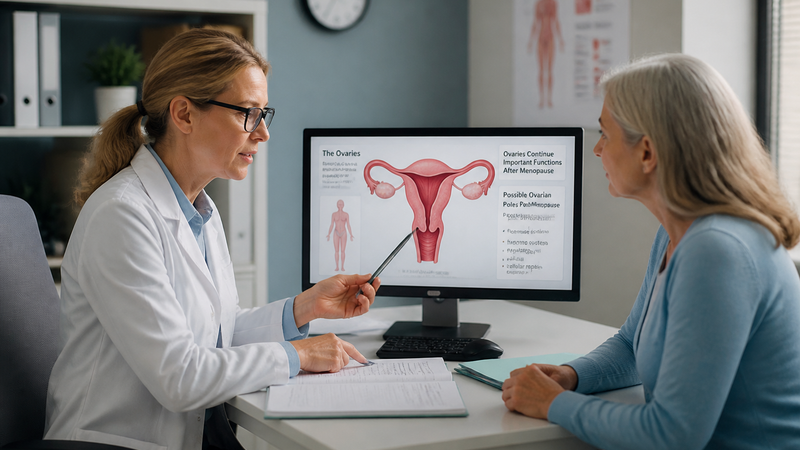
Your Ovaries May Still Be Working After Menopause — Here's What Scientists Found
A surprising new discovery suggests the ovaries don't simply shut down at menopause — they may take on an entirely different biological role.
Most people assume the ovaries go quiet after menopause. No more eggs, no more hormones, end of story. But a new study is turning that assumption on its head — and the implications for women's health could be significant.
What Scientists Thought They Knew
For decades, the medical understanding was straightforward: ovaries exist to produce eggs and reproductive hormones like estrogen and progesterone. Once menopause arrives and those functions wind down, the ovaries were considered largely inactive tissue.
That picture may now need to be redrawn.
What the New Research Found
Researchers studying postmenopausal ovarian tissue discovered that these organs don't simply go dormant. According to findings published in Nature Cell Biology, the postmenopausal ovary appears to remain biologically active — not in a reproductive sense, but in ways scientists are only beginning to understand.
The research identified continued cellular activity in ovarian tissue after menopause, suggesting the organ may shift into a new functional role rather than simply switching off. It is important to note that this is an early-stage area of research, and scientists are still working to determine exactly what that role is and what it means for health outcomes.
Why This Matters for Women Over 40
If the ovaries remain active after menopause, it raises important questions about how we think about women's health in the second half of life. Could the postmenopausal ovary be influencing systems beyond reproduction — such as immune function, metabolism, or aging at the cellular level?
Researchers don't have definitive answers yet. But the discovery opens new doors for studying conditions that disproportionately affect postmenopausal women, including cardiovascular disease, bone loss, and certain cancers.
The Limits of What We Know Right Now
It is worth being clear about what this research does — and doesn't — tell us. This is an early and emerging area of science. The studies examining postmenopausal ovarian activity are still in relatively early stages, and we are not yet at the point where these findings translate into specific medical recommendations or treatments.
As with any new discovery in biology, the path from "interesting finding in tissue" to "actionable health guidance" takes time, rigorous study, and replication across larger and more diverse populations.
What This Could Mean Down the Road
If scientists confirm that the postmenopausal ovary plays an active biological role, it could eventually reshape how doctors think about ovary-removal surgery (oophorectomy), hormone therapy, and even how aging is studied in women. Some researchers have already raised questions about whether removing healthy ovaries at the time of a hysterectomy — a common practice for decades — may have downstream effects that weren't fully appreciated.
Again, these are research questions, not conclusions. But they are the kind of questions that could lead to meaningful advances in women's health science.
What You Can Do Now
You don't need to wait for the science to mature to take your postmenopausal health seriously. Here are a few grounded steps worth discussing with your doctor:
- Ask about your ovarian health history. If you've had surgery that affected your ovaries, make sure your doctor knows and factors that into your care.
- Stay current on cardiovascular and bone health screenings. These remain among the most important health priorities after menopause.
- Talk to your doctor before making any changes to hormone therapy or other medications based on emerging research. Early findings, however exciting, are not yet a basis for changing your treatment plan.
- Follow the research. This is a fast-moving area of science. Staying informed — through sources that report accurately on study size and limitations — is always a smart move.
The Bottom Line
New research suggests the ovaries may remain biologically active after menopause, potentially playing a role that goes beyond reproduction. It is early science, and we don't yet know what it means for your health in practical terms. But it is a genuine shift in how researchers are thinking about postmenopausal biology — and it is a reminder that the female body continues to surprise us. Stay curious, stay informed, and bring your questions to your doctor.
