

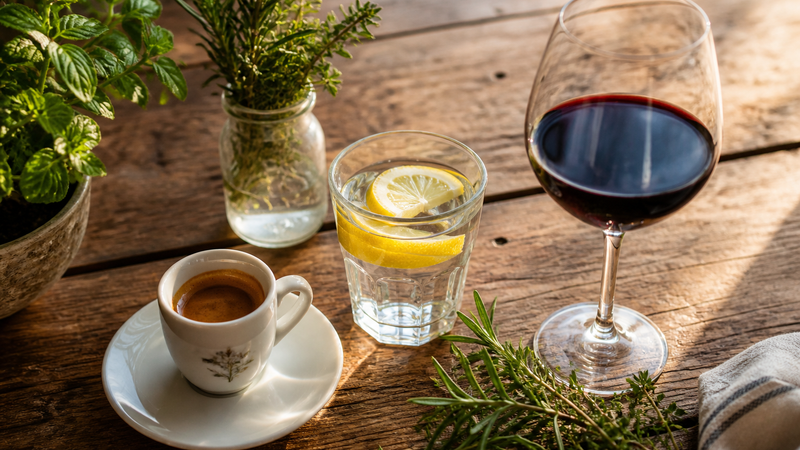
What Centenarians Actually Drink Every Day and Why It Matters
Researchers studying the world's longest-lived people keep noticing the same three drinks in their daily routines.
You might assume that living to 100 requires some impossible combination of perfect genes and radical discipline. But researchers who study centenarians around the world keep finding something surprisingly ordinary at the center of their daily lives: what they drink. Coffee, water, and red wine show up again and again in the diets of people who live the longest. Here's what the science actually says about each one.
The Blue Zone Connection
Much of what we know about centenarian drinking habits comes from research on so-called Blue Zones — regions of the world where people consistently live longer than average. These include Sardinia in Italy, Okinawa in Japan, Ikaria in Greece, Nicoya in Costa Rica, and Loma Linda in California.
National Geographic explorer and longevity researcher Dan Buettner has spent decades documenting the lifestyle habits of these communities. Diet and daily beverages are a consistent thread across nearly all of them. It's worth noting that Blue Zone research is largely observational, meaning it can identify patterns but cannot prove that any single habit is the direct cause of a longer life.
Coffee: More Than a Morning Ritual
In Ikaria, Greece — a small island where an unusually high proportion of residents live past 90 — strong Greek coffee is a daily tradition. Researchers from the University of Athens published a study in the journal Vascular Medicine finding that Ikarians who drank boiled Greek coffee had better endothelial function, meaning the cells lining their blood vessels were healthier, compared to those who drank other types of coffee or none at all. The study was small and conducted in one population, so it can't be applied universally.
Broader research on coffee and longevity has been more encouraging. A large observational study published in The New England Journal of Medicine involving more than 400,000 older adults found that regular coffee consumption was associated with a lower risk of death from heart disease, respiratory disease, stroke, diabetes, and infections. Again, association is not causation — coffee drinkers may share other healthy habits that influence the findings.
Coffee contains hundreds of biologically active compounds beyond caffeine, including antioxidants and anti-inflammatory polyphenols. Researchers believe these compounds may contribute to the drink's observed health associations, though more study is needed.
Water: The One Nobody Debates
Staying well-hydrated doesn't generate the same headlines as coffee or red wine, but longevity researchers consistently note that the world's longest-lived populations drink water throughout the day — and drink it consistently, not just when they feel thirsty.
Here's something that surprises many people: the sense of thirst becomes less reliable as we age. Older adults are more prone to mild chronic dehydration without realizing it, and even mild dehydration is linked to fatigue, difficulty concentrating, and kidney strain over time.
There is no universal daily water target that applies to everyone — needs vary by body size, activity level, climate, and diet. But most health authorities, including the U.S. National Academies of Sciences, Engineering, and Medicine, suggest a general daily intake of about 3.7 liters of total water for men and 2.7 liters for women, from all food and drink sources combined. If you're over 50, making a conscious habit of drinking water regularly — rather than waiting until you're thirsty — is a simple and essentially risk-free longevity practice.
Red Wine: A Little, With a Meal, and Not for Everyone
This is the drink that needs the most context. In Sardinia and Ikaria, moderate red wine consumption — typically one small glass per day, usually with food and shared with others — is a long-standing cultural tradition among people who live exceptionally long lives. Buettner and other researchers who have studied these populations note that wine appears as part of a broader social and dietary pattern, not as a standalone health strategy.
Red wine contains resveratrol, a polyphenol found in grape skins that has attracted significant scientific interest for its potential anti-inflammatory and antioxidant properties. However, resveratrol research in humans has been mixed, and scientists have not established that resveratrol from wine consumed at normal amounts is directly responsible for health benefits.
Observational studies in some populations have linked light-to-moderate alcohol consumption with lower rates of cardiovascular disease. But this is a complicated and evolving area. The World Health Organization and other major health bodies have moved toward stating that no level of alcohol consumption is entirely without risk, particularly when it comes to certain cancers. Heavy drinking is clearly harmful. And for people with a personal or family history of alcohol use disorder, liver disease, or certain other conditions, any amount is not appropriate.
If you don't currently drink, no longevity researcher is recommending you start. If you do drink, the centenarian pattern — a small glass of red wine with dinner, in the context of an otherwise healthy lifestyle — is quite different from drinking in isolation or in larger quantities.
What These Three Drinks Have in Common
Notice what's not on this list: soda, heavily sweetened beverages, and high-calorie specialty drinks. The common thread among the drinks centenarians favor is that they are simple, low in sugar, and consumed in modest, consistent amounts as part of a daily rhythm — not as an occasional indulgence or a health intervention.
Researchers also point out that in Blue Zone communities, beverages are typically part of a larger lifestyle that includes a mostly plant-based diet, regular low-level physical movement, strong social connections, and a sense of purpose. No single drink explains longevity on its own.
The Bottom Line
The drinking habits of the world's longest-lived people are less exotic than you might expect. Coffee, water, and — for some populations — a small daily glass of red wine appear consistently in their routines. The science behind each is real but also nuanced: observational research can show associations, not guarantees. What the centenarian pattern really points to is consistency, moderation, and integrating healthy habits into a daily routine rather than chasing any single miracle fix. Start with the simplest one: drink more water, every day, without waiting to feel thirsty. Then talk with your doctor about what else might fit your individual health picture.
