

The One Workout Over-50s Keep Skipping That Could Save Their Life
Falls are the leading cause of injury death in older adults — and one simple training habit may be your best defense.
You probably track your cardio minutes. Maybe you lift weights or take a yoga class. But there is one type of exercise that most people over 50 completely overlook — and according to public health experts and growing research, skipping it could be one of the costliest mistakes you make for your long-term health and independence.
That exercise is balance training. And it deserves a permanent spot in your weekly routine.
Why Balance Starts to Slip After 50
Balance is not just about how steady you feel on your feet. It is a complex system that involves your inner ear, your eyesight, the muscles and joints throughout your body, and your brain — all working together in real time.
After about age 50, each part of that system begins to change. Muscle mass declines, nerve signaling slows, and the vestibular system in the inner ear becomes less sensitive. The result is a gradual erosion of stability that most people do not notice until something goes wrong.
The National Institute on Aging notes that these changes are normal with aging but are not inevitable in their impact — the right kind of exercise can meaningfully slow the decline.
The Fall Risk Numbers Are Stark
The Centers for Disease Control and Prevention reports that falls are the leading cause of injury-related death among adults 65 and older. Each year, millions of older Americans are treated in emergency departments for fall-related injuries, and hundreds of thousands are hospitalized for hip fractures alone.
What makes this especially important is how quickly one fall can change a person's life. A hip fracture can trigger a cascade of complications — reduced mobility, loss of independence, and for a significant portion of older adults, a serious decline in overall health within the following year.
These are not just statistics. They represent the difference between living actively on your own terms and needing long-term care.
What the Research Says About Balance Training
Here is where the encouraging news comes in. A large body of evidence suggests that balance-focused exercise can significantly reduce fall risk in older adults.
A review published in the British Journal of Sports Medicine, which pooled data from dozens of randomized controlled trials involving thousands of older adults, found that exercise programs that challenged balance — such as tai chi, single-leg standing, and targeted strength work — were associated with meaningful reductions in fall rates. The researchers concluded that balance and functional exercises were among the most effective fall-prevention strategies studied.
It is worth noting that most studies in this area involve adults 65 and older, so the research base for the 50 to 65 age group is still growing. But experts at the National Institute on Aging recommend starting balance training well before problems develop — making your 50s an ideal time to build the habit.
What Balance Training Actually Looks Like
You do not need a gym, special equipment, or an hour to spare. Many of the most effective balance exercises can be done at home in a few minutes a day.
Some options to discuss with your doctor or a physical therapist include:
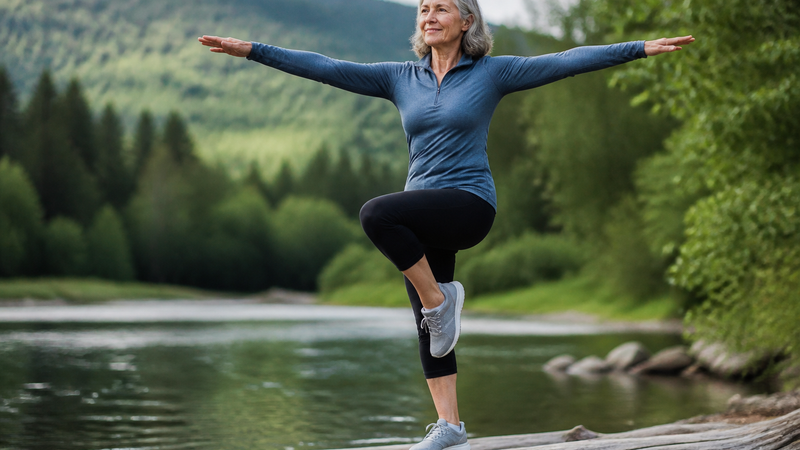
- Single-leg stands: Stand on one foot for 10 to 30 seconds, then switch. Hold a counter if needed and gradually reduce your grip over time.
- Heel-to-toe walking: Walk in a straight line placing one foot directly in front of the other, like walking a tightrope.
- Tai chi: This ancient movement practice has been studied extensively and is consistently linked to lower fall rates in older adults. Many community centers and YMCAs offer beginner classes.
- Standing on an unstable surface: A folded towel or a balance board adds challenge once you have a solid foundation.
- Strength training for the legs and core: Squats, calf raises, and core exercises support the muscles that keep you upright.
Start simple and progress gradually. The goal is to challenge your system just enough to force adaptation — not to push to the point of risk.
How to Fit It Into Your Week
The good news is that balance training does not need its own dedicated workout slot. You can weave it into your day with almost no extra time.
Try standing on one foot while you brush your teeth. Do a few heel-to-toe steps down a hallway. Add calf raises while you wait for your coffee to brew. These micro-sessions add up, and consistency matters far more than duration when it comes to training the balance system.
If you have had a previous fall, feel unsteady, or have a condition that affects your legs or inner ear, talk to your doctor before starting. A physical therapist can design a program tailored to your specific needs and starting point.
The Bottom Line
Cardio protects your heart. Strength training protects your muscles and bones. But balance training may be the exercise most directly tied to staying independent, mobile, and safe as you get older. The research consistently links balance-focused movement with lower fall risk — and the habits are simple enough to start today. Stand on one foot while you brush your teeth tonight. Then talk to your doctor about building a fuller routine. Your future self will thank you.
