

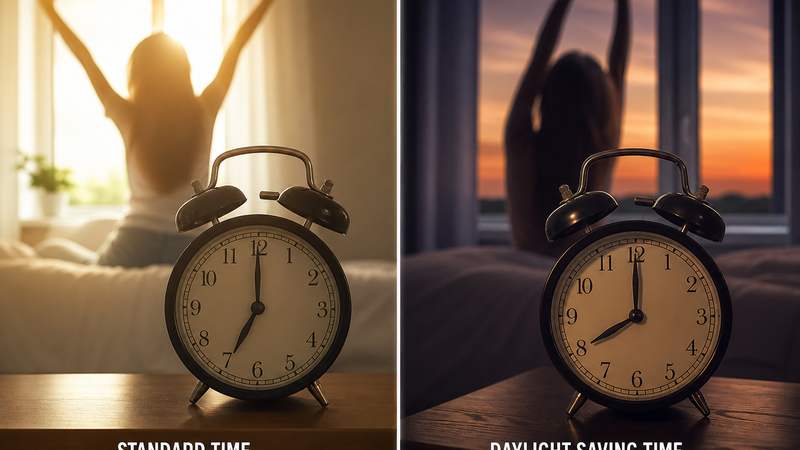
Standard Time vs. Daylight Saving Time: What Science Says About Your Health
The debate over changing our clocks twice a year has moved from a policy argument to a public health one — and researchers are starting to weigh in.
Most of us groan when the clocks change, lose an hour of sleep, and move on. But a growing body of research suggests the real issue isn't just the inconvenience — it's which time system our bodies are better built for. Here's what the science says.
Your Body Runs on Solar Time — Whether You Like It or Not
Inside your brain is a master clock called the suprachiasmatic nucleus. It governs when you feel awake, when you get hungry, when your core body temperature rises and falls, and when you feel ready for sleep. That clock takes its cues primarily from the sun — specifically, when light hits your eyes in the morning.
Standard time is designed so that the sun is roughly overhead at noon, which lines up closely with solar noon. Daylight saving time (DST) shifts that by an hour, meaning the sun peaks at what the clock calls 1 p.m. For your internal clock, that hour-long mismatch may not sound like much — but researchers argue it adds up.
What the Research Actually Shows
Scientists have a term for the gap between social clock time and your body's internal time: social jetlag. A study published in the journal Current Biology found that people living on the western edge of a time zone — where the sun rises and sets later relative to the clock — tend to experience more social jetlag and have worse health outcomes, including higher rates of obesity, diabetes, and certain metabolic conditions, compared to people on the eastern edge of the same time zone.
That research involved large population-level data and was observational, meaning it shows an association, not a direct cause-and-effect relationship. But it suggests that when your internal body clock and your social schedule are chronically out of sync, there may be measurable health consequences over time.
Separate research has looked specifically at the transition to DST in spring. Studies have linked the one-hour "spring forward" shift to a short-term increase in heart attacks, workplace injuries, and traffic accidents in the days immediately following the change. A 2020 analysis published in the Journal of Internal Medicine reviewed decades of data and found a small but consistent uptick in cardiovascular events after the spring clock change.
Where Sleep Scientists Stand
The American Academy of Sleep Medicine (AASM) has taken a formal position on this debate. In 2020, the organization published a statement calling for the elimination of seasonal time changes — and specifically advocated for permanent standard time, not permanent daylight saving time.
Their reasoning comes down to light exposure and circadian biology. Under permanent standard time, morning light arrives earlier, which helps anchor the body's internal clock and supports healthier sleep patterns. Permanent DST, by contrast, would push morning light later throughout the year — which the AASM argues could worsen chronic social jetlag, particularly in winter months when sunrise is already late.
It's worth noting that this represents the position of a professional medical organization, not a single study. Individual sleep researchers have varying views, and the science continues to evolve.
What About the Benefits of Evening Light?
Supporters of permanent DST often point to the benefits of extra evening daylight: more time to exercise outdoors after work, lower rates of seasonal depression in some people, and economic benefits like reduced energy use and increased activity in the evening hours. These are real considerations, and the research on them is genuine.
The tension here is that what feels good socially — a bright evening in summer — may not always align with what your biology prefers. Most sleep researchers argue that morning light is more biologically important than evening light for setting the body's clock and promoting healthy sleep. But this doesn't mean evening light has no value. It's a trade-off, and where you land may depend on your individual chronotype — whether you're naturally an early bird or a night owl.
The Clock Change Itself May Be the Biggest Problem
Here's something both sides tend to agree on: the twice-yearly switching may be more harmful than either permanent system. The disruption to sleep, mood, and cardiovascular function that spikes in the days after each time change is well-documented. Many health and policy experts argue that picking one system — either one — and sticking with it year-round would be better for public health than the current back-and-forth.
As of this writing, the U.S. Senate passed the Sunshine Protection Act in 2022, which would have made DST permanent, but the bill did not advance through the House. Many states have also passed legislation expressing preferences, but federal law still governs time-zone changes, so the debate continues.
What You Can Do Right Now
Whatever the policy outcome, there are practical steps you can take to protect your sleep and circadian health through any clock change:
- Get morning light early. Step outside within an hour of waking up, even on cloudy days. Natural light is far brighter than indoor lighting and helps anchor your body's internal clock.
- Shift your schedule gradually. In the days before a clock change, adjust your bedtime and wake time by 15 to 20 minutes each day to ease the transition.
- Dim screens after dark. Bright light in the evening — especially from phones and tablets — pushes your body clock in the wrong direction.
- Keep a consistent sleep schedule. Going to bed and waking at the same time every day, including weekends, is one of the most powerful things you can do for sleep quality.
- Talk to your doctor if clock changes regularly leave you feeling off for more than a week or two, or if you have a heart condition that makes you wonder about added risk.
The Bottom Line
The science increasingly suggests that permanent standard time may be the better fit for human biology, largely because it keeps morning light aligned with the body's natural clock. But the research is still evolving, and the most immediate harm may come from the clock changes themselves rather than which system we settle on. Whatever happens in Washington, you have real tools — morning light, consistent sleep schedules, and smart evening habits — to protect your health through the next time change and beyond.
