

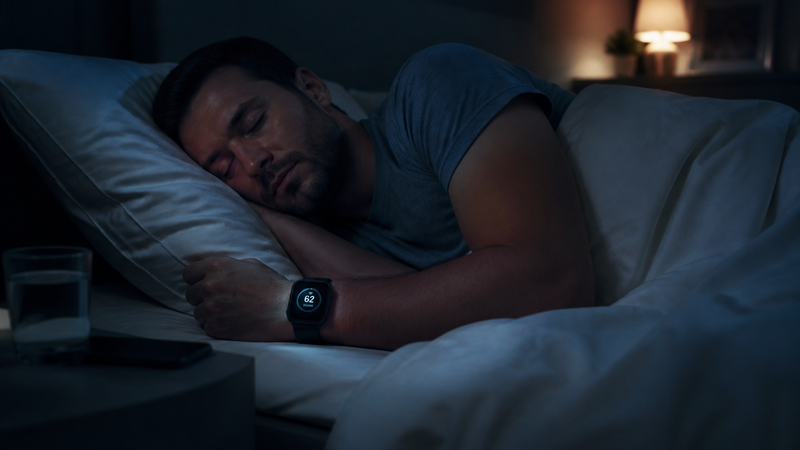
Sleep Trackers Promise a Lot—But Can They Really Read Your Brain?
Your smartwatch counts your deep sleep stages every night—but how close is it to the truth?
Millions of people wake up, check their wrist, and let a number on a screen decide whether they had a good night's sleep. But sleep scientists have a few things to say about that. The technology is getting better—and it still has real limits worth understanding.
What Your Wrist Sensor Is Actually Measuring
Consumer sleep trackers—think Fitbit, Apple Watch, Garmin, Oura Ring—don't measure brain activity directly. They rely primarily on accelerometers, which detect movement, and optical heart rate sensors, which measure pulse changes through the skin.
From those signals, the device's algorithm estimates when you were awake, in light sleep, in deep sleep, or in REM sleep. It's an educated guess, not a direct reading of what your brain was doing.
True sleep staging requires a polysomnography (PSG) test—a clinical sleep study that measures brain waves, eye movements, muscle activity, and breathing simultaneously. That's the gold standard, and it happens in a sleep lab, not on your nightstand.
What the Research Actually Shows
Studies published in the Journal of Clinical Sleep Medicine and other peer-reviewed journals have compared consumer wearables against polysomnography in real subjects. The general finding: these devices are reasonably good at distinguishing sleep from wakefulness overall, but they struggle when it comes to specific sleep stages.
Detecting deep sleep (slow-wave sleep) and REM sleep with precision is harder for wrist sensors. Some studies have found that trackers tend to overestimate total sleep time and can misclassify stages at rates that vary significantly by device and individual.
Accuracy also appears to vary based on factors like skin tone, body position, wrist movement, and how tightly the device fits. A 2023 analysis flagged that some devices perform less accurately in people with darker skin tones due to how optical sensors interact with melanin—an important limitation the industry is working to address.
It's also worth noting that most validation studies involve relatively small samples, and results can differ across brands and firmware versions. No single tracker has been shown to match clinical sleep lab accuracy consistently.
Where Trackers Do Add Real Value
Here's what consumer sleep trackers genuinely do well: they track trends over time. Seeing that you consistently sleep fewer than six hours on nights before early meetings, or that your heart rate stays elevated after a late glass of wine, is genuinely useful information.
The American Academy of Sleep Medicine has acknowledged that wearable sleep technology can be a helpful tool for raising awareness about sleep habits and prompting conversations with a doctor—even if the stage-by-stage data isn't clinical-grade.
Think of your sleep score less like a lab result and more like a daily snapshot. A single night's number isn't the story. The pattern across weeks is where the insight lives.
The "Orthosomnia" Risk—When Tracking Hurts Sleep
There's a catch that sleep researchers have started to flag. Some people become so focused on achieving a perfect sleep score that the anxiety itself disrupts their rest. Sleep specialists have given this phenomenon a name: orthosomnia, meaning an obsession with getting optimal sleep data.
If you find yourself lying awake worrying about your deep-sleep percentage, or waking up in a bad mood because your tracker gave you a low score despite feeling rested, that's a sign the data may be working against you.
Researchers writing in the Journal of Clinical Sleep Medicine have described cases where patients' sleep worsened after they began tracking it obsessively. How you feel in the morning—your energy, mood, and alertness—remains a valid and important signal that no algorithm can replace.
How to Use a Sleep Tracker Wisely
- Look at weekly and monthly trends, not just last night's score.
- Use the data as a conversation starter with your doctor, especially if you consistently score poorly or feel chronically tired despite what looks like adequate sleep.
- Don't treat your sleep stage breakdown as clinical fact. It's an estimate.
- If tracking is making you anxious, it's okay to turn the detailed metrics off or take a break.
- If you suspect a sleep disorder like sleep apnea or insomnia, talk to your doctor about a proper sleep evaluation—no wrist device can diagnose those conditions.
The Bottom Line
Consumer sleep trackers are useful wellness tools, not medical devices. They can help you spot patterns, build better habits, and flag concerns worth discussing with your doctor—but they cannot read your brain the way a clinical sleep study can. Use the data as a guide, trust how you actually feel, and talk to your doctor if something seems off. Your wrist sensor is a starting point, not the final word.
