

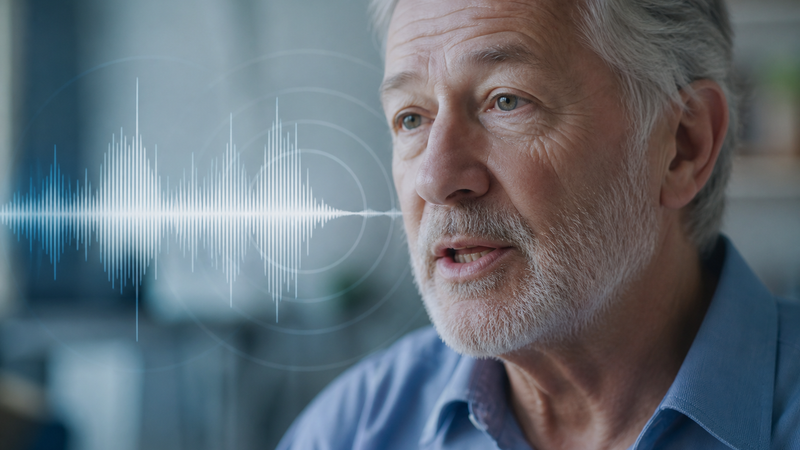
How the Sound of Your Voice Could Signal Dementia Years Early
Researchers are finding that subtle changes in how you speak may reveal brain changes long before memory problems appear.
You probably think of dementia as something doctors detect through memory tests or brain scans. But a growing body of research suggests your voice may give you away first — sometimes years before any other symptoms show up. Here is what the science says, and what it might mean for early detection.
What Researchers Are Actually Listening For
Scientists studying voice biomarkers are not listening for whether you sound confused. They are analyzing subtle, measurable features of speech that the human ear would never catch — things like tiny pauses between words, slight changes in pitch and rhythm, a slowdown in the rate of syllables, and subtle shifts in vocal tone.
These acoustic patterns can reflect changes in how the brain plans and produces language, a process that involves multiple regions affected early in Alzheimer's disease and other forms of dementia.
What the Research Has Found So Far
Several studies have explored whether speech and language patterns can distinguish people with mild cognitive impairment or early Alzheimer's from healthy adults. Researchers at institutions including MIT, Boston University, and the University of Toronto have used machine learning tools to analyze recorded speech and found that automated analysis can detect differences that are not visible to a trained clinician listening in real time.
One line of research has focused on a simple task: describing a picture. Known as the Cookie Theft picture description task, it has been used for decades in clinical settings. When researchers feed those recordings into AI-powered analysis tools, the software picks up on hesitations, word-finding pauses, reduced vocabulary variety, and changes in sentence complexity — all of which may signal early cognitive decline.
It is important to note that most studies in this area have been relatively small or conducted in controlled research settings. This research is promising but still early. Voice analysis is not yet a validated clinical tool for diagnosing dementia, and scientists are still working to understand how well findings hold up across different languages, accents, and populations.
Why the Voice Reflects What Is Happening in the Brain
Speech is one of the most cognitively demanding things we do. Forming a sentence in real time requires memory, attention, planning, and coordination between multiple brain regions. That is why subtle breakdowns in speech can serve as an early window into brain health.
The areas of the brain involved in language and verbal fluency — including parts of the frontal and temporal lobes — are among those affected in the early stages of Alzheimer's disease. Changes there can show up in speech before they are obvious on standard cognitive tests.
Could Your Phone Eventually Screen for Dementia Risk?
That is the direction some researchers are heading. Because voice analysis can be done passively — through a phone call, a short recorded task, or even smart home devices — it has potential as a low-cost, non-invasive screening tool that could reach people who would never make it to a memory clinic.
Several research teams and startups are working on apps and platforms that could detect cognitive changes over time by comparing a person's voice recordings to their own baseline. The idea is that tracking change within an individual, rather than comparing to a population average, may be more sensitive to early decline.
This technology is not ready for routine use today. Researchers still need larger, longer-term studies to confirm accuracy and to ensure these tools work fairly across diverse groups of people.
What You Can Do Right Now
Voice-based screening is not something you can access as a clinical tool yet, but there are practical steps worth taking.
- Pay attention to changes in verbal fluency. If you or someone close to you notices more frequent word-finding struggles, trailing off mid-sentence, or unusual pauses, bring it up with a doctor. These can have many causes, not just dementia, and a clinician can help sort it out.
- Keep your brain engaged. Activities that challenge language and memory — reading, conversation, learning something new — support the same brain networks that speech relies on.
- Ask your doctor about cognitive screening. Standard cognitive assessments are available now and can establish a baseline, especially if you have a family history of dementia or are over 60.
- Stay on top of cardiovascular health. High blood pressure, diabetes, and high cholesterol are linked to higher dementia risk. Managing them is one of the most evidence-backed ways to protect brain health long term.
The Bottom Line
Your voice carries more information than most people realize. Emerging research suggests that subtle shifts in how you speak — detected by AI tools, not the human ear — may signal early brain changes linked to dementia, sometimes years before memory problems appear. The science is still developing and voice screening is not yet a clinical reality, but this research points toward a future where catching dementia early could be as simple as speaking into your phone. For now, stay on top of your brain health, know your risk factors, and talk to your doctor if you notice any changes in your memory or language.
