

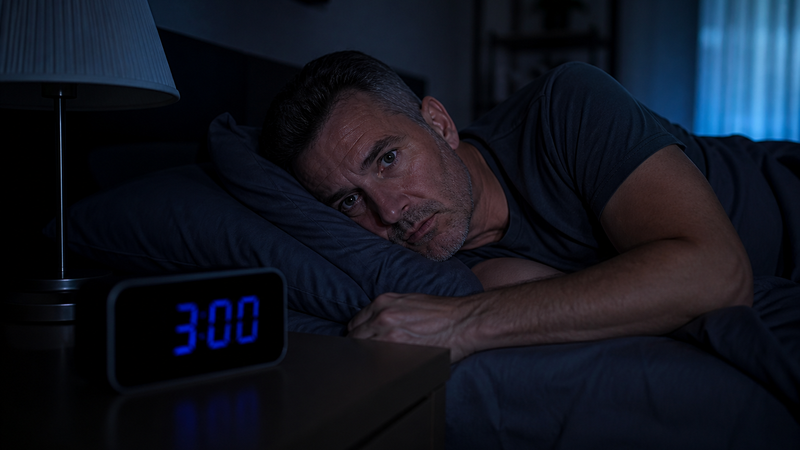
How Poor Sleep May Be Quietly Draining Your Testosterone
You might be working out, eating right, and still falling short — and your sleep schedule could be why.
Most men think about testosterone in the gym or the doctor's office. But one of the biggest factors affecting your levels might be happening — or not happening — in your bedroom every night. Research suggests that how long and how well you sleep has a direct impact on your body's ability to produce this critical hormone.
What the Research Actually Found
A study published in the Journal of the American Medical Association (JAMA) by researchers at the University of Chicago looked at what happens to testosterone levels when healthy young men cut their sleep short. The researchers studied 10 healthy young men who slept a full 8 hours for one week, then restricted to just 5 hours a night for the following week.
After just one week of shortened sleep, daytime testosterone levels fell by 10 to 15 percent. The researchers noted that this kind of drop is similar to what would be expected with aging 10 to 15 years. That's a significant finding — though it's worth noting this was a small study of young men, so results may not apply to everyone.
Why Sleep and Testosterone Are So Tightly Linked
Here's something most people don't know: the majority of your daily testosterone is produced while you sleep. Specifically, testosterone production ramps up during the deeper stages of sleep, particularly during REM sleep in the early morning hours.
When you cut sleep short, you're cutting into that production window. Your body simply doesn't have enough time to do the job. Think of it less like a hormone problem and more like a manufacturing problem — the factory doesn't get enough overnight shift hours to fill the order.
What Low Testosterone Actually Feels Like
Testosterone isn't just about muscle and libido, though those get most of the attention. It plays a role in energy, mood, focus, bone density, and even cardiovascular health.
Low levels are linked to fatigue, brain fog, irritability, reduced motivation, and difficulty building or maintaining muscle — even with regular exercise. Many men chalk these symptoms up to stress or just getting older, when poor sleep may be a contributing factor worth addressing first.
It Goes Both Ways
Here's where it gets more complicated. Low testosterone can also disrupt sleep. Men with lower levels are more prone to sleep apnea, a condition where breathing repeatedly stops and starts during the night. Sleep apnea, in turn, fragments sleep and further suppresses testosterone production.
This cycle — poor sleep lowers testosterone, low testosterone worsens sleep — is one reason experts say it's important to look at both issues together. If you suspect either problem, a conversation with your doctor is the right starting point. There are tests for both.
What You Can Do Starting Tonight
You don't need a prescription to start protecting your sleep — and potentially your hormone levels. Here are evidence-based habits worth building:
- Prioritize 7 to 9 hours. The National Sleep Foundation recommends this range for adults. Consistently falling short adds up fast.
- Keep a consistent schedule. Going to bed and waking up at the same time every day — including weekends — helps anchor your body's internal clock.
- Watch the alcohol. A nightcap might help you fall asleep, but alcohol suppresses REM sleep, which is precisely when testosterone production peaks.
- Cool your room down. Sleep quality improves in a cooler environment. Most sleep researchers suggest somewhere between 65 and 68 degrees Fahrenheit.
- Cut screens before bed. Blue light from phones and tablets delays melatonin release and can push your sleep cycle in the wrong direction.
- Talk to your doctor about sleep apnea. If you snore loudly, wake up unrefreshed, or feel exhausted despite a full night in bed, ask about a sleep study. Untreated sleep apnea is one of the most common and correctable causes of both poor sleep and low testosterone.
A Note on What This Research Doesn't Say
The JAMA study was small — just 10 participants — and focused on young, healthy men. It doesn't prove that fixing your sleep will restore testosterone to any particular level, and it doesn't replace a clinical evaluation. Testosterone levels are affected by many factors, including age, weight, chronic illness, medications, and stress.
If you're concerned about your testosterone, talk to your doctor about getting your levels tested. Don't self-diagnose or self-treat based on a single study.
The Bottom Line
Sleep is not optional recovery time — it's when your body does some of its most important hormonal work. Research from the University of Chicago suggests that even one week of short sleep can measurably reduce testosterone in men. If your energy, mood, or performance has been off and you've been skimping on sleep, that's a reasonable and free place to start. Get consistent, quality sleep first — and if you're still struggling, bring both your sleep and your hormone concerns to your doctor for a full picture.
