

Could Banking Your Hair Today Save Your Locks Tomorrow?
Scientists are exploring whether freezing your hair follicles today could give you more options if hair loss strikes later in life.
Most people don't think about their hair until it starts to thin. By then, some options are already off the table. A cutting-edge concept called hair banking asks a simple but forward-thinking question: what if you could preserve your healthiest follicles now, before hair loss begins?
The science is still early, but the idea is gaining real traction in research labs. Here's what you need to know.
What Is Hair Banking?
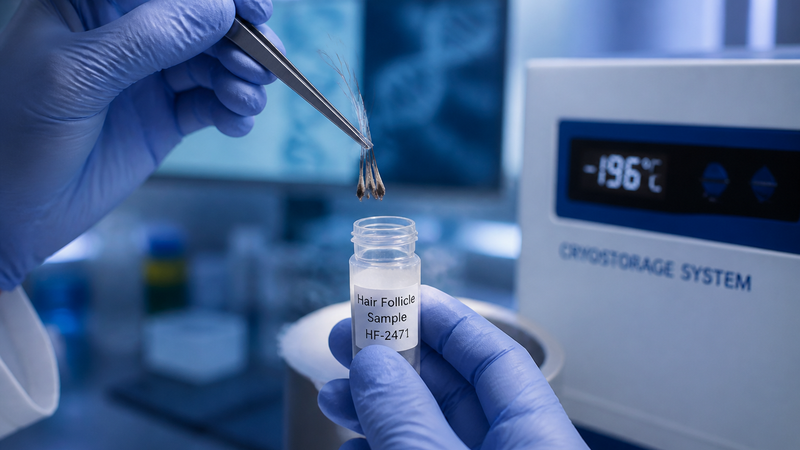
Hair banking is the process of collecting and cryogenically freezing hair follicle cells — essentially storing them for potential future use in hair restoration treatments.
The concept draws on the same logic as banking cord blood at birth. You're preserving biological material at its healthiest, with the hope that advances in medicine will allow it to be used therapeutically down the road.
Right now, hair banking is not a standard medical treatment. It is an experimental strategy being explored in conjunction with emerging research into hair follicle regeneration.
The Science Behind It
Researchers at Columbia University Irving Medical Center published findings in the journal Nature Communications that brought new attention to this field. Their work focused on growing human hair follicles in a lab setting — something scientists had struggled with for decades.
The Columbia team used a 3D printing-inspired technique to create tiny chambers that mimicked the environment hair follicles need to thrive. Within those chambers, they were able to get human hair follicle cells to grow new hair shafts in the lab. This was considered a meaningful step forward, though the research is still in early stages and has not yet been tested as a clinical treatment in humans at scale.
The key limitation: what works in a laboratory environment doesn't always translate directly to a treatment that works safely and effectively in people. More research is needed before this becomes a real clinical option.
Who Might Benefit — and When
Hair follicles appear to lose some of their regenerative capacity over time, which is part of why hair loss becomes harder to reverse as we age. The thinking behind hair banking is that younger, healthier follicle cells may have more potential for future use than older, damaged ones.
For people in their 30s and 40s who have a family history of hair loss, or who are beginning to notice early thinning, the concept is especially relevant. Waiting until hair loss is advanced may mean fewer viable follicle cells to work with.
That said, no clinical guidelines currently recommend hair banking as a standard preventive step. Anyone considering it should talk with a dermatologist or hair restoration specialist who can weigh their individual situation.
What Exists Today
A small number of private companies have begun offering hair follicle banking services, typically involving the collection of a follicle sample that is then cryogenically preserved. These services are not regulated the same way FDA-approved treatments are, and because the therapeutic use of banked follicles is still experimental, there is no guarantee the stored cells will ever be usable in a clinical treatment.
Established hair restoration options — including FDA-approved medications like minoxidil and finasteride, as well as surgical hair transplantation — remain the standard of care today. These options work best when started early. If hair loss is a concern, talking with your doctor sooner rather than later is still the most evidence-backed move you can make.
Natural Steps That Support Hair Health Now
While the research on hair banking matures, there are well-supported lifestyle habits that may help protect the hair you have.
- Nutrition matters: Deficiencies in iron, zinc, biotin, and protein have been linked to hair loss. A balanced diet rich in these nutrients supports healthy follicle function.
- Manage stress: Significant physical or emotional stress is a known trigger for a type of hair shedding called telogen effluvium. Chronic stress management — through sleep, exercise, or mindfulness — may help.
- Be gentle: Heat styling, tight hairstyles, and harsh chemical treatments can damage follicles over time. Gentler hair care habits are a low-risk, high-value step.
- See a dermatologist early: Many causes of hair loss are treatable, especially when caught early. Don't wait until the loss is significant.
The Bottom Line
Hair banking is a genuinely fascinating idea rooted in real science, but it's still experimental. The Columbia University research published in Nature Communications shows that growing hair follicles in the lab is becoming possible — which is a meaningful step. However, no proven clinical treatment using banked follicles yet exists. If you're concerned about hair loss, the most important thing you can do right now is talk with your doctor or a dermatologist. Early action with proven tools is still your best bet — and the science of what comes next is worth watching closely.
