

Can Art, Music, and Theater Actually Protect Your Mental Health?
Going to concerts, museums, and plays may do more for your mind than you think — here's what the latest research suggests.
Most of us think of mental health care as something that happens in a doctor's office. But what if part of the answer was a night at the symphony, an afternoon at the museum, or a local theater production? Emerging research says it might be.
What the Research Found
A study published in The Gerontologist, a peer-reviewed journal from Oxford Academic, examined the relationship between cultural engagement and mental health outcomes in older adults. Researchers looked at whether activities like attending concerts, visiting museums, going to the theater, or taking part in community arts events were associated with better psychological wellbeing.
The findings suggest that older adults who participated more frequently in these kinds of cultural activities reported better mental health outcomes, including lower rates of depression and higher levels of life satisfaction, compared to those who engaged less often.
It's important to note that this type of research shows an association, not a direct cause-and-effect relationship. The study cannot tell us whether cultural engagement caused better mental health, or whether people who are already in better mental health are simply more likely to go out and participate.
Why This Could Matter for Aging Adults
Mental health challenges are common among older adults. Depression affects an estimated one in five people over 55, according to the Centers for Disease Control and Prevention, and social isolation is a well-documented risk factor for cognitive decline.
Cultural activities hit several known protective factors at once. They get people out of the house, into social settings, and mentally stimulated — all things that research has long linked to better brain health and emotional resilience as we age.
The Social Connection Factor
One reason cultural engagement may matter is the social element. Going to a concert or a gallery opening puts you in the same room as other people, often around a shared experience. That social connection is not a small thing.
Loneliness and social isolation have been linked to higher risks of depression, cognitive decline, and even early death, according to research published by the National Academies of Sciences, Engineering, and Medicine. Activities that bring older adults into community settings — whether it's a museum visit or a community choir — may help counter those risks.
Active vs. Passive Engagement
The research in this space often distinguishes between two types of cultural engagement: receptive, which means attending events as an audience member, and active, which means actually making art, playing music, or performing.
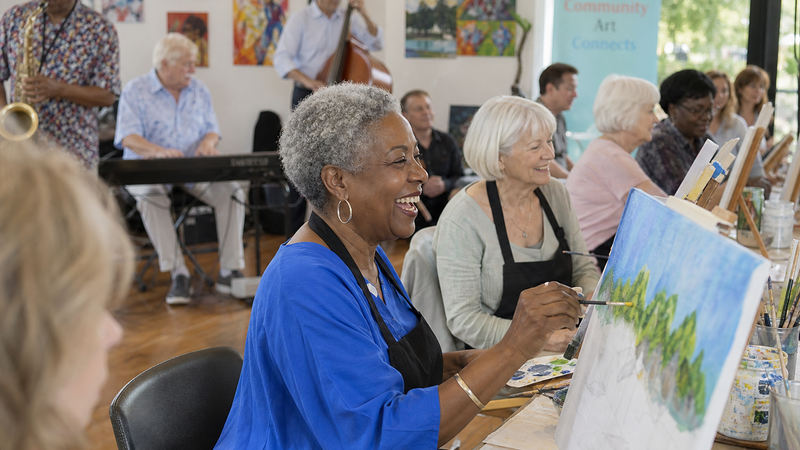
Both appear to offer benefits, but some studies suggest that active participation — taking a painting class, joining a community band, or writing in a group — may carry an extra edge by adding a sense of purpose, mastery, and creative expression. If you have a creative interest that's been sitting on the back burner, this might be the nudge to revisit it.
What You Can Realistically Do
You don't need to live near a world-class museum or concert hall to put this into practice. Many communities offer low-cost or free cultural programming through libraries, senior centers, local theaters, and parks departments.
- Check your local library for free museum passes or arts events
- Look into community orchestras, choirs, or art classes for adults
- Visit a local gallery, botanical garden, or historic site
- Invite a friend — the social element amplifies the benefit
- Search for senior-focused arts programs in your area
If mobility or transportation is a challenge, many arts organizations now offer virtual programming, online concerts, and streaming performances that can bring cultural engagement into your home.
Important Caveats
This research is promising, but it's not a prescription. Cultural engagement should be seen as one healthy addition to a full picture of mental wellness — not a replacement for professional care if you're struggling with depression, anxiety, or another mental health condition.
If you're experiencing persistent low mood, loss of interest in things you used to enjoy, or other symptoms of depression, please talk with your doctor. There are effective treatments available, and no one should go without support.
The Bottom Line
The next time you're deciding between staying home and going out to a concert, a museum, or a local theater show, consider this: that outing may be doing more for your mental health than you realize. Research suggests that regular cultural engagement is linked to lower rates of depression and higher life satisfaction in older adults. It won't replace good medical care, but it just might make life feel a little richer — and that's worth something.
