

At-Home Lab Tests Are Everywhere—But What Can They Really Tell You?
DIY lab kits promise a window into your health—here's what the science says about what they can and can't deliver.
You've probably seen the ads: a tiny finger prick, a prepaid envelope, and a full health report in your inbox within days. At-home health testing has exploded into a multi-billion-dollar industry, and the options keep growing. But before you order a kit, it helps to know what these tests actually measure, how reliable the results are, and when you still need a doctor in the loop.
What At-Home Tests Can Actually Measure
Today's consumer lab kits cover a surprisingly wide range of health markers. Depending on the company and the kit, you can test things like cholesterol and blood sugar levels, thyroid hormones (TSH, T3, T4), vitamin D and B12 levels, key sex hormones such as testosterone, estrogen, and DHEA, food sensitivity markers, and even genetic risk factors through DNA-based tests.
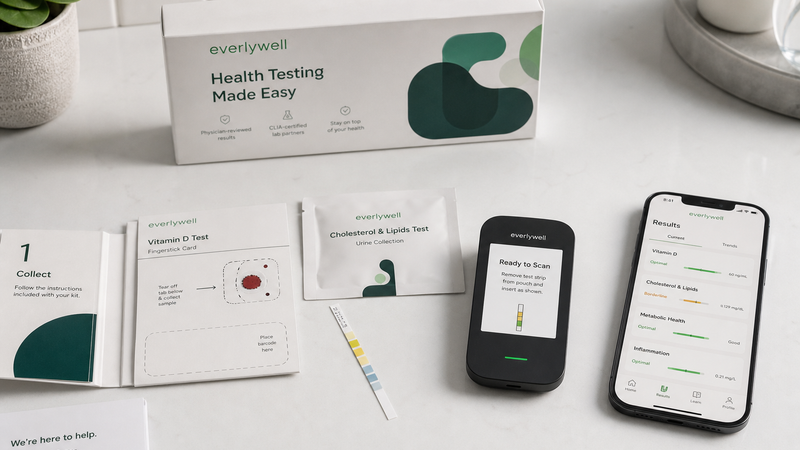
Most kits use a finger-prick dried blood spot sample, a urine sample, or a cheek swab. You collect the sample at home, mail it to a certified laboratory, and receive your results online—sometimes with a brief explanation of what the numbers mean.
For certain markers, at-home testing is genuinely convenient and can provide real information. Vitamin D deficiency, for example, is common and often goes undetected. Knowing your level can be a useful starting point for a conversation with your doctor.
The Accuracy Question—And Why It Matters
Here's where things get more complicated. The accuracy of at-home tests varies widely depending on the company, the type of test, and how carefully you follow the collection instructions.
The U.S. Food and Drug Administration (FDA) regulates laboratory-developed tests and certain direct-to-consumer diagnostic tests, but the level of oversight differs depending on how a product is classified. Some at-home kits use CLIA-certified labs—the same standard applied to hospital laboratories—which is a meaningful quality marker to look for.
Finger-prick blood samples can also produce slightly different results than blood drawn from a vein in a clinical setting. A 2018 review published in the Journal of Applied Laboratory Medicine noted that dried blood spot testing shows strong concordance with standard venous draws for many analytes, but variations can occur depending on the marker being measured and the collection technique.
The bottom line on accuracy: look for kits that use CLIA-certified labs, and treat any result—whether reassuring or alarming—as a starting point, not a final answer.
What These Tests Are Not Designed to Do
At-home kits are screening tools, not diagnostic tools. There's an important difference. A screening result tells you something may be worth looking at more closely. A diagnosis requires a clinical exam, a full medical history, and often additional testing by a licensed provider.
A test showing slightly elevated thyroid markers, for instance, does not mean you have a thyroid disorder. Many factors can influence hormone levels on any given day, including stress, recent illness, time of collection, and even what you ate beforehand.
Food sensitivity tests sold directly to consumers deserve special mention. Immunoglobulin G (IgG) food sensitivity panels are widely marketed but are not considered diagnostic by major medical organizations. The American Academy of Allergy, Asthma and Immunology has stated that IgG testing is not a reliable method for identifying food sensitivities or allergies. True food allergies require proper allergy testing by a qualified clinician.
When At-Home Testing Makes Sense
For the right person and the right marker, these kits can be genuinely useful. If you have risk factors for vitamin D deficiency, are monitoring a known condition between doctor visits, or want a snapshot of basic markers to bring to an appointment, at-home testing can fill a gap.
They're also valuable for people who face barriers to regular lab work—limited access to healthcare, cost concerns, or simply the challenge of fitting a doctor's appointment into a busy schedule.
The key is using results to start a conversation with your doctor, not to skip one. If a result comes back out of range, your next call should be to a healthcare provider who can order a confirmatory test and interpret it in the context of your full health picture.
Genetics Tests: Useful Information, Careful Interpretation Required
Direct-to-consumer genetic tests, like those offered by 23andMe and similar companies, can reveal ancestry information and flag certain genetic variants associated with health risks. The FDA has authorized some of these tests to report on specific genetic health risks, such as variants linked to BRCA1 and BRCA2 genes associated with breast and ovarian cancer risk, or variants associated with late-onset Alzheimer's disease.
Important caveat: these tests look at selected variants, not your entire genome. A negative result does not mean you have no genetic risk for a condition—it means the specific variants the test checks for were not detected. Genetic counselors and medical genetics specialists are trained to help interpret these results in a meaningful way, and for high-stakes findings, that professional guidance is worth seeking out.
The Bottom Line
At-home health testing has real value as a convenient, accessible way to track certain markers and stay engaged with your health between doctor visits. The best kits use certified labs, test markers that are well-validated for home collection, and give you clear guidance on what to do with your results. What they can't do is replace a clinician who knows your full history. Use them as a starting point, not a shortcut—and always loop in your doctor when a result raises a question.
