

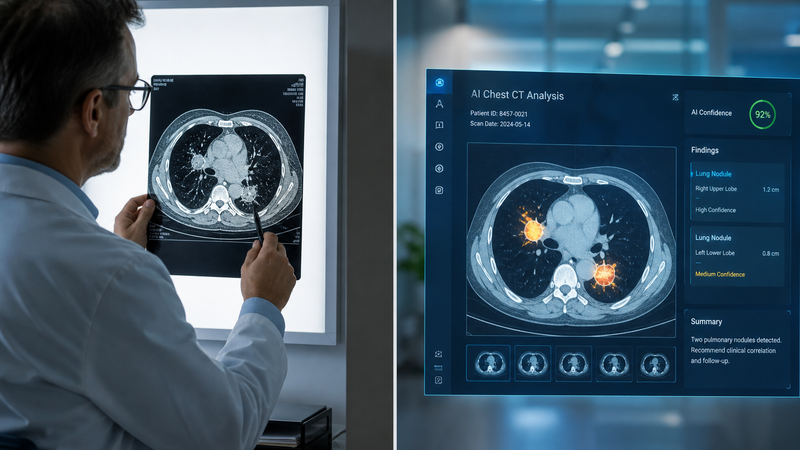
AI Is Catching Diseases Doctors Used to Miss — Here's How
Machine learning tools are finding cancers, heart problems, and neurological conditions earlier than ever — and the science behind them is moving fast.
You go in for a routine scan or an annual checkup. Everything looks normal. But what if something was there that the human eye simply couldn't catch? Artificial intelligence is changing that equation — and in some cases, it's catching life-threatening conditions years before symptoms appear.
Here is what the research actually says, and what it means for your health today.
What AI Detection Actually Means
When doctors talk about AI in medicine, they are usually talking about machine learning — a type of software trained on enormous datasets of medical images, lab results, or patient records. The system learns to recognize patterns associated with disease, sometimes patterns too subtle for the human eye to spot consistently.
This is not science fiction. These tools are already in use at major hospitals and research centers, and several have received clearance from the U.S. Food and Drug Administration.
Spotting Cancer Earlier
One of the most studied applications is cancer screening. A landmark study published in Nature Medicine in 2020 found that a Google Health AI system detected breast cancer in mammograms with greater accuracy than six radiologists reviewing the same images, reducing both false positives and false negatives. The study analyzed data from more than 76,000 women in the United States and United Kingdom.
Lung cancer detection is another active area. Researchers at Northwestern University and Google published findings in Nature Medicine showing that an AI model outperformed radiologists at identifying early-stage lung cancer on low-dose CT scans. Early detection matters enormously here — lung cancer caught at stage one has a five-year survival rate dramatically higher than cancer found at later stages.
It is important to note that these studies compare AI to radiologists working alone. In practice, the most promising approach may be AI and doctors working together, with the AI flagging areas of concern for a physician to review.
Heart Disease: Finding Risk Before a Crisis
Heart disease is the leading cause of death in the United States, and it often gives no warning until a heart attack or stroke occurs. AI tools are now being studied as a way to find risk earlier.
Researchers published findings in The Lancet Digital Health describing an AI system that can detect a condition called low ejection fraction — a sign of a weakened heart — simply by analyzing a standard electrocardiogram (ECG). A normal ECG reading looks fine to the human eye in these cases, but the AI identified hidden patterns linked to heart failure. The study involved tens of thousands of patients at the Mayo Clinic.
Similarly, AI tools are being trained to analyze retinal photographs — images of the back of the eye — to predict cardiovascular risk. Because the blood vessels in the retina reflect the health of vessels throughout the body, researchers believe a routine eye scan could one day double as a heart health screening.
Brain Health and Neurological Conditions
Early detection of Alzheimer's disease and other forms of dementia is one of the hardest problems in medicine, because by the time symptoms appear, significant brain changes have already occurred.
Studies published in peer-reviewed journals have shown that AI systems analyzing brain MRI scans or speech patterns may be able to identify early signs of cognitive decline years before a clinical diagnosis. Researchers at Boston University and other institutions have explored whether subtle changes in language — picked up through recorded speech — can serve as an early biomarker. This research is still in relatively early stages, and larger, longer studies are needed before these tools are ready for routine clinical use.
For now, the honest takeaway is that this science is promising but not yet ready to replace standard clinical evaluation of brain health.
What AI Cannot Do — and Why That Matters
It would be easy to read these headlines and assume AI is about to replace your doctor. That is not what the evidence supports.
AI tools are trained on specific datasets, and they can struggle when applied to populations or imaging equipment that differ from what they were trained on. They can produce false positives, which lead to unnecessary follow-up tests and anxiety. And they are only as good as the quality of the data fed into them.
Regulatory agencies including the FDA require clinical validation before these tools reach patients, and most experts emphasize that AI works best as a tool to support — not replace — physician judgment. If an AI flags something on your scan, a doctor still needs to interpret what that finding means for you specifically.
What This Means for You Right Now
You do not need to do anything differently today based on AI research alone. What you can do is stay current with the screenings your doctor recommends — mammograms, colonoscopies, lung cancer screening if you qualify, and regular cardiovascular checkups. Those are the settings where AI-assisted tools are most likely to benefit you as they become more widely available.
If you are curious about whether an AI-assisted screening tool is available at your healthcare system, it is a reasonable question to ask your doctor. Some major health systems are already using FDA-cleared AI tools for specific screenings.
The Bottom Line
Artificial intelligence is not a miracle cure, but it is a genuine and fast-moving advance in early disease detection. Studies involving tens of thousands of patients suggest these tools may catch cancers, heart conditions, and neurological changes that would otherwise go unnoticed until they became harder to treat. The technology works best alongside — not instead of — your physician. Keep up with your recommended screenings, ask your doctor what AI-assisted tools may be available to you, and stay tuned: this field is advancing quickly.
