

Your Sleep Tracker Is Useful — But Here's What It Can't See
Consumer sleep trackers have come a long way — but sleep specialists say there's still a lot they miss.
You wake up, check your app, and it tells you exactly how much deep sleep you got. Feels pretty official, right? The truth is, your wrist-worn tracker is making an educated guess — and for most healthy adults, that's fine. But for people with real sleep problems, that guess can fall short in important ways.
What Your Tracker Is Actually Measuring
Most consumer sleep trackers — think Fitbit, Apple Watch, Oura Ring, and Garmin — track movement and heart rate. Some also measure heart rate variability, skin temperature, and blood oxygen levels.
From those signals, the device's algorithm estimates when you were awake, in light sleep, in deep sleep, or in REM sleep. It's a reasonable approximation, but it is an approximation. The device never directly measures your brain.
What a Sleep Lab Actually Does
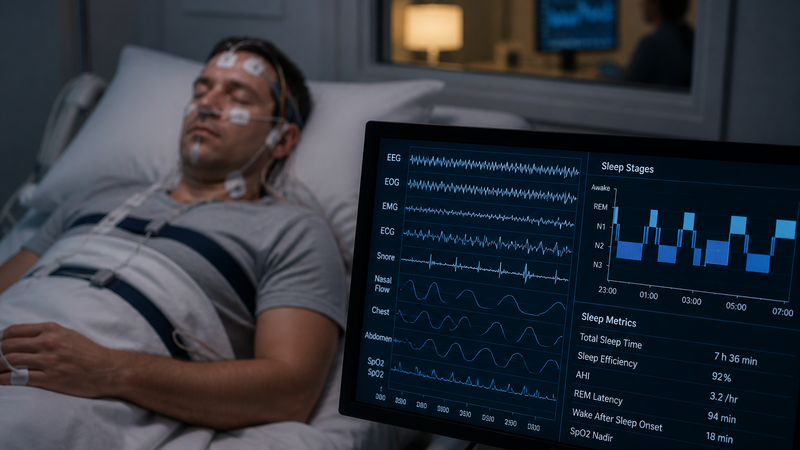
A clinical sleep study — called a polysomnogram, or PSG — is a different animal entirely. Conducted in a sleep lab or sometimes at home with medical-grade equipment, a PSG measures brain wave activity (EEG), eye movements, muscle tone, heart rhythm, breathing patterns, blood oxygen, and leg movements simultaneously throughout the night.
It's this brain wave data — the EEG — that allows sleep specialists to precisely identify sleep stages. Deep sleep and REM sleep have distinct electrical signatures in the brain that no wrist sensor can pick up. The American Academy of Sleep Medicine considers the PSG the gold standard for diagnosing sleep disorders.
Where Trackers Fall Short
Research published in the Journal of Clinical Sleep Medicine has found that while consumer trackers can do a reasonable job estimating total sleep time, they tend to be less accurate when it comes to identifying specific sleep stages — particularly deep sleep and REM sleep.
Studies have also found that trackers generally overestimate sleep efficiency, meaning they may log you as asleep during periods when you were actually awake but lying still. For someone trying to understand a real sleep problem, that gap in accuracy matters.
There's another limitation worth knowing: current consumer devices cannot reliably detect sleep apnea, periodic limb movement disorder, or other clinical conditions. These require the full picture that only a PSG can provide.
When a Tracker Is Plenty
For most healthy adults who simply want to build better sleep habits or track general trends over time, a consumer tracker offers genuinely useful information. Noticing that you consistently sleep less on nights when you have a late dinner or a glass of wine? That's actionable data.
Trackers can also be a helpful first conversation starter with your doctor. If your device consistently shows fragmented sleep or low sleep scores, that's worth bringing up at your next appointment.
When You Should See a Sleep Specialist
If you regularly feel exhausted despite what looks like enough hours of sleep, if you snore loudly or have been told you stop breathing at night, if you have unexplained morning headaches, or if daytime sleepiness is affecting your work or safety — those are signs that a clinical evaluation makes sense.
A sleep specialist can order a PSG or a home sleep test to look for conditions like obstructive sleep apnea, which affects an estimated 30 million Americans and often goes undiagnosed for years. A tracker won't catch it. A sleep study can.
Talk with your doctor about whether a formal sleep evaluation is right for you — especially if you have tried improving your sleep habits and still don't feel rested.
The Bottom Line
Sleep trackers are a convenient, low-cost way to build awareness of your sleep patterns, and for general wellness use, they have real value. But they work by estimating brain activity from movement and heart rate — and that means they have limits that a clinical sleep study does not. If your sleep problems go beyond occasional restless nights, the gold standard is still a conversation with your doctor and, if needed, a proper sleep evaluation. Your tracker can be the starting point. It shouldn't be the final word.
