

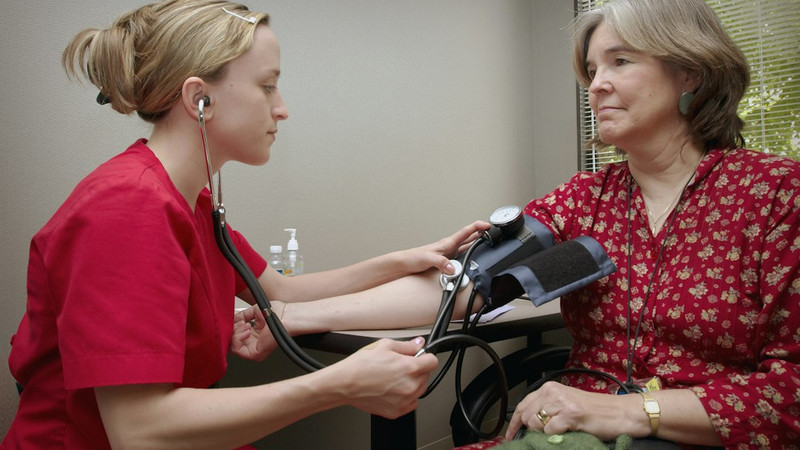
Where you rest your arm during a blood-pressure check can meaningfully change the result, a Johns Hopkins Medicine study found.
Among 133 adults, leaving an arm unsupported at the side raised systolic blood-pressure readings—the top number—by an average of 6.5 mmHg compared with resting the arm on a desk at heart level. Resting the arm on the lap raised systolic readings by an average of 3.9 mmHg.
The finding does not mean that every high reading is wrong. It shows why correct positioning and repeat measurements matter before hypertension is diagnosed or treatment is changed.
What the study found
Researchers tested three common seated positions:
- Arm supported on a desk at heart level
- Arm supported on the lap
- Arm hanging unsupported at the side
The desk position was the reference point because it follows recommended measurement practices. Participants completed repeated readings in each position using an automated upper-arm blood-pressure monitor.
Compared with desk support, an arm resting in the lap raised average systolic pressure by 3.9 mmHg and average diastolic pressure—the bottom number—by 4.0 mmHg.
An unsupported arm at the side raised systolic pressure by 6.5 mmHg and diastolic pressure by 4.4 mmHg. The study was published in JAMA Internal Medicine.
Why a few points matter
A small difference can affect how a reading is interpreted.
For example, a systolic reading of 123 mmHg could appear closer to 130 mmHg if the arm is not properly supported. A reading of 133 mmHg could appear near 140 mmHg, a threshold that may fall into a higher blood-pressure category under current U.S. guidelines.
One reading should not be used by itself to diagnose hypertension. Blood pressure changes throughout the day and can be affected by stress, physical activity, caffeine, nicotine, pain, illness, medications, talking during a measurement, or anxiety in a medical setting.
Still, inaccurate technique can add avoidable noise to an already variable measurement. That is why clinicians often repeat readings and may recommend home or ambulatory blood-pressure monitoring before diagnosing high blood pressure or changing medication.
How to get a more accurate reading
For a seated reading, use these practical steps:
- Sit quietly for about 5 minutes beforehand.
- Keep your back supported.
- Place both feet flat on the floor.
- Keep your legs uncrossed.
- Use a cuff that fits your upper arm properly.
- Place the cuff on a bare upper arm.
- Rest your arm on a table or desk, with the cuff at heart level.
Avoid talking, texting, scrolling, or moving while the cuff is inflating.
The study participants emptied their bladders, walked briefly, then rested before testing. Researchers used cuff sizes matched to participants’ upper-arm circumference and took multiple readings in a quiet setting.
What you can do
If a reading is unexpectedly high, it is reasonable to ask whether you can sit quietly for a few minutes and repeat the measurement with your back supported, feet flat, and arm resting on a stable surface.
At home, set up your chair, table, and monitor before taking a reading. Record the date, time, reading, and any factors that could have affected it, such as caffeine, exercise, stress, illness, or missed medication. Bring those readings to a healthcare appointment rather than relying on memory.
Do not ignore repeatedly elevated readings because one measurement may have been poorly positioned. And do not start, stop, or change medication based on a single result.
Study limitations
The study was conducted during one visit and used automated blood-pressure devices. Its exact results may not apply to every manual reading, home monitor, clinic, or patient population.
Even so, the central message is straightforward: arm position can materially affect a reading, and supporting the arm on a desk or table at heart level is an easy way to improve measurement accuracy.
The bottom line
Blood-pressure checks are only as useful as the technique behind them.
A dangling arm can make a reading appear nearly 7 mmHg higher than a properly supported arm in this study. The goal is not to obtain a lower number—it is to obtain an accurate one.
Medical disclosure: This article is for general educational and informational purposes only. It is not medical advice and does not replace care from a qualified healthcare professional. Do not start, stop, or change blood-pressure medication based on one reading or this article. Seek urgent medical care for chest pain, sudden weakness or numbness, trouble speaking, severe shortness of breath, fainting, a sudden severe headache, or other symptoms of a possible medical emergency.
