

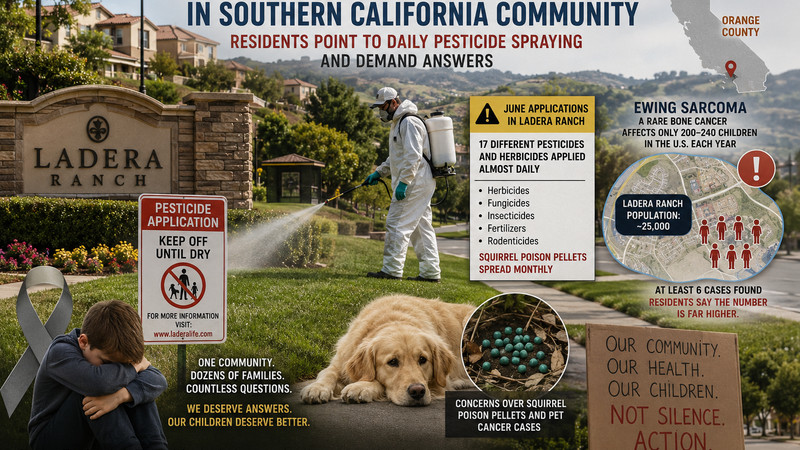
Six children in a small, affluent Southern California enclave have been diagnosed with one of the rarest bone cancers in the country. Now residents say the number is far higher—and they are pointing at what gets sprayed on the lawns and common areas around them nearly every single day.
A cancer that almost never happens this often
Ewing sarcoma strikes only about 200 to 240 children across the entire United States each year.
For at least six cases to surface in one community of roughly 25,000 people in Ladera Ranch, Orange County, is statistically extraordinary.
But residents now say six is just the start.
After one mother posted in a local Facebook group asking neighbors whether anyone in their household had been diagnosed with cancer, she received 62 responses—from a group of only a few thousand members.
Some replies described three people with brain cancer living on the same street.
An unusually high number of pets developing cancer was also reported across the community.
None of those reports have been independently verified, and they do not constitute an official cancer cluster determination. But for the people living there, the pattern has become impossible to look away from.
What residents believe is behind it
Locals have spent months filing public records requests, reviewing pesticide application notices and documenting their community’s landscaping practices.
What they found has alarmed many of them.
Records show 17 different pesticides and herbicides were applied throughout Ladera Ranch during June alone, with applications occurring almost daily.
Those notices technically comply with California law—but are posted only on a hard-to-find website that most residents never knew existed.
Squirrel poison pellets are also spread throughout the community each month.
Some homeowners worry that dogs may ingest the pellets or track pesticide residue into their homes after walks, noting that many dogs in the area have developed cancer or begun chewing at their paws after time spent outdoors.
Landscaping crews have been observed wearing full protective gear while spraying chemicals near schools.
Former residents have described developing headaches after applications and moving away after years of failed attempts to get community leaders to take the issue seriously.
What the science says—and does not say
Researchers have explored possible associations between pesticide exposure and certain childhood cancers, including Ewing sarcoma, but no direct causal relationship has been confirmed in the scientific literature.
That distinction matters: a pattern of illness in one zip code is not proof that a specific chemical caused it.
UC Irvine environmental health expert Bruce Blumberg said the community’s concerns deserve serious attention even without a confirmed link.
Many California cities have already moved to organics-first landscape management, and Blumberg has argued there is no compelling reason to keep using synthetic chemicals near children when safer alternatives exist and are already in use elsewhere.
Where the investigation stands
The California Cancer Registry is reportedly reviewing the reported cases, though officials have cautioned the process could take months.
The Orange County Health Care Agency has also reportedly reopened its review after residents renewed calls for a formal investigation.
Neither agency had publicly commented at the time of publication.
The Ladera Ranch Maintenance Corporation, which oversees landscaping in the community, expressed sympathy for affected families but said it has no evidence linking its practices to the illnesses.
It announced plans to form an advisory committee of homeowners, board members and landscaping professionals to review current practices—a step residents said they welcome, while noting that similar concerns have been raised since at least 2016 without meaningful resolution.
One 17-year-old resident, Brody Matteson, died in March after battling Ewing sarcoma. His death is what prompted his mother to reach out to the community and ultimately set this latest wave of investigation in motion.
With a teenager gone and dozens of families raising their hands, the community says it is not dropping the issue this time.
Disclaimer: The information in this article is for educational purposes only and is not a substitute for professional medical advice, diagnosis, or treatment. If you have concerns about environmental exposures and potential cancer risk in your community, contact your local or state health department and speak with a qualified medical professional.

