

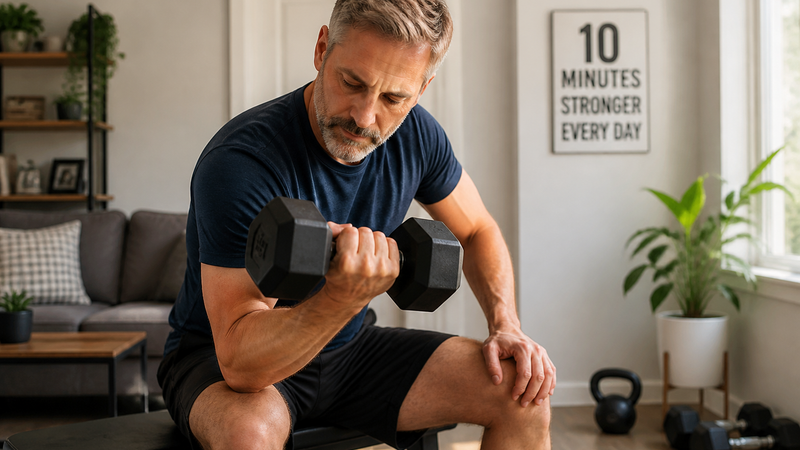
10 Minutes of Strength Training a Day May Keep Muscle Loss at Bay
You don't need an hour at the gym to hold on to your muscle — here's what the research actually says.
Most people assume meaningful strength training requires a serious time commitment. A full hour, a weight room, a personal trainer. But a growing body of research suggests that even short bouts of resistance exercise — as little as 10 minutes — may deliver real benefits for adults over 40 who want to protect their strength and independence as they age.
Why Muscle Loss Is a Bigger Deal Than Most People Realize
Starting around age 30, adults begin losing muscle mass — a process called sarcopenia. After 40, that loss can accelerate, and without some form of resistance training, the body can lose roughly 3 to 5 percent of muscle mass per decade, according to information published by Harvard Medical School.
Less muscle doesn't just mean less strength. It's linked to slower metabolism, weaker bones, reduced balance, and a higher risk of falls and fractures. Protecting your muscle is one of the most practical things you can do for long-term health and quality of life.
What the Research Says About Short Workouts
The American College of Sports Medicine (ACSM) recommends that adults perform resistance training at least two days per week. But the guidelines don't require long sessions — they emphasize consistency and effort over duration.
Research published in the Journal of Strength and Conditioning Research has explored whether abbreviated resistance training sessions can produce meaningful results. Studies in this space consistently suggest that even a single set of exercises performed to the point of muscle fatigue can stimulate strength gains, particularly in people who are new to resistance training or returning after a break.
It's worth noting that most of these studies involve relatively small groups of participants over limited time periods, so they point to a promising direction rather than a definitive prescription. More research, especially in larger and more diverse populations, is still needed.
What 10 Minutes Might Actually Look Like
A focused 10-minute session isn't about going through the motions — it's about choosing a few compound movements that work multiple muscle groups at once and doing them with enough effort to challenge your body.
Exercises like squats, push-ups, lunges, and rows hit the major muscle groups in the legs, core, chest, and back. You don't need weights to get started. Bodyweight exercises done consistently and with good form can be enough, especially early on.
Here's a simple starting framework:
- Squats or chair squats: 10 to 15 reps
- Push-ups (on knees if needed): 8 to 12 reps
- Stationary lunges: 10 reps per leg
- Glute bridges: 12 to 15 reps
- Plank hold: 20 to 30 seconds
Move through these with minimal rest and you've got a full-body session in under 10 minutes.
Consistency Beats Duration — Every Time
Here's the thing about short workouts: they only work if you actually do them. And one reason short sessions are valuable is that people are far more likely to stick with them.
Research consistently shows that perceived time barriers are one of the top reasons adults skip exercise. A 10-minute commitment is much easier to fit into a busy day than a 60-minute gym session — and a workout you do regularly beats a perfect routine you abandon after two weeks.
If 10 minutes becomes easy, you can always add more. But starting small and building a habit is often more effective than going all-in and burning out.
A Few Things to Keep in Mind
If you have any existing joint issues, heart conditions, or haven't been active in a while, it's a good idea to check with your doctor before starting a new strength training routine. This is especially true for adults over 60 or anyone managing a chronic health condition.
Proper form matters more than speed or weight. Moving slowly and with control reduces injury risk and makes each rep more effective. If you're unsure about technique, a single session with a certified personal trainer or a physical therapist can go a long way.
The Bottom Line
You don't need to carve out an hour or join a gym to start protecting your muscle and strength. Research suggests that even 10 focused minutes of resistance exercise, done consistently a few times a week, may help adults over 40 slow muscle loss and stay stronger for longer. The best workout is the one you'll actually do — so start small, stay consistent, and talk to your doctor if you have any health concerns before jumping in.
